Available from Amazon as a paperback and eBook
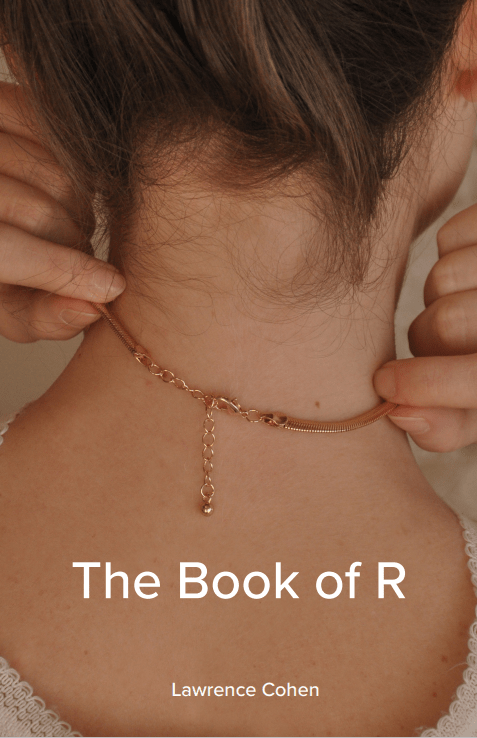
A novel of love, loss and redemption which follows the fortunes of Becca Burns and Joe Pinsker as they negotiate a succession of relationships in the last decade of the 20th century.
From the blurb:
A fracas over a Hebrew name necklace sets off a chain of events leading eighteen-year-old Becca Burns to seek refuge with distant relations in Israel – only to discover that her hosts, Hannah and Nahum Yerushalmi, harbour religious expectations that they have neglected to spell out in detail. Swallowing her pride, Becca extends her projected stay of nine months to three years – a decision which will have far-reaching consequences.
On her return to the UK, Becca has a fleeting encounter with fellow student Joe Pinsker at a bruising rugby match. Becca confesses to him that their subsequent ‘chance’ meeting is, in fact, a setup, leaving Joe uncertain as to why Becca has made a beeline for him. But then Joe, generous in love, poor in pocket, is perhaps way too credulous for his own good.
Two years later, an unexpected phone call will leave four lives in turmoil.
Writer, Ingrid Stone, interviews the author:
Ingrid Stone: Who or what inspired you to write The Book of R?
Lawrence Cohen: I had intended to write a crime thriller, but my creation, Joe Pinsker, a drug busting Jewish Metropolitan Police detective, lost the plot. I was about to bin the manuscript, when Joe’s fictional girlfriend, Becca Burns, begged me to give her and Joe another chance. Okay, I said, show me what you can do. What she did was to cast herself as the heroine in an updated version of the biblical The Book of Ruth.
IS: Except in The Book of Ruth, if I’m not mistaken, Ruth, doesn’t get entangled in anyone else’s marriage. That’s stretching it a bit, isn’t it?
LC: Poetic licence. The Book of R is essentially a 20th century tale of coming of age and beyond.
IS: And the ending is less cut and dried than the biblical account. Won’t some readers be disappointed?
LC: Possibly. Let’s just say that Becca and Joe defied all my attempts to wave them off into a golden sunset. Anyway, I’d prefer not to reveal any more, except to mention that the setting is the 1990’s – when folk still wrote each other letters and weren’t obsessed with their smart phones. And I’ve woven into the narrative several themes which I hope will strike a chord with readers.
IS: For instance?
LC: Family. Becca’s non-Jewish father has roots both in the North-East and in Ireland, whereas her maternal grandparents are comfortable Hampstead dwellers, albeit they cannot shake off the shadow of a Holocaust trauma. By contrast, Joe’s family are ex East Enders – Dad’s a cab driver with a penchant for Yiddish, Mum runs a ladies’ foundation shop – shades of my late auntie Yetta, God dressed her soul.
IS: And there’s the Israeli couple, Hannah and Nahum Yerushalmi; what about them?
LC: Ah yes, the other pair in the mix. Hannah is born into a Dutch farming community, while Nahum’s parents are a fusion of Ashkenazy and Mizrahi, European and Middle Eastern Jews.
IS: Love conquers all in a cowshed if I remember correctly?
LC: Spot on! I encourage my characters to leap cultural and religious boundaries.
IS: And Becca lands on the Yerushalmis’ Jerusalem doorstep following a personal crisis, right?
LC: Correct. And before long she becomes embedded in the family. Let’s leave it there.
IS: So, are there any other themes you would like to mention?
LC: Yes: assimilation. Becca regards herself as a typical Geordie lass. Her world revolves around her North country cousins. She only starts to question who she is after a brush with anti-Semitism. Joe is inclined to give Jews a wide berth. He’s in a relationship with Deepika and, pre-Becca, he’s never had a Jewish girlfriend. The very thought of attending a Jewish function gives Joe the heebie-jeebies.
IS: He’s not alone! At the other end of the spectrum, you are clearly fascinated with people from non-observant backgrounds who are drawn towards Orthodoxy.
LC: Absolutely. Becca is nonplussed by religious faith. Although the more she is immersed in the life of the Yerushalmi family, the greater the pull of frumkeit – strict observance. And once she has bought in, it is unlikely that she will ever budge – except when it suits her.
IS: It sounds like you have drawn on a lot of autobiographical material. Are you Joe Pinsker in disguise?
LC: Hardly. Joe plays rugby but can’t read Hebrew; I’m the exact reverse! Though I did infiltrate Becca into my schooldays; she is asked by her teacher to explain Jewish feasts and fasts to her Newcastle classmates. Becca, like my younger self, is the only Jewish child in the school, and doesn’t have a clue.
IS: Newcastle to Jerusalem: quite a leap! What makes you confident that your portrayal of Israel and Israelis is accurate?
LC: Between 1967 and the noughties, I was a regular visitor, and I hope my recollections hold good.
IS: So, why are you self-publishing rather than going through the regular channels?
LC: A good question. Publishers are rarely excited by a new author unless they have confidence in the writer’s commercial appeal. I suspect that the book will only attract a limited, well-defined readership. That’s why I am publishing on Amazon. But you never know – if Spielberg came knocking, I could certainly turn the novel into a film script.
IS: Echoes of The Fabelmans?
LC:Modesty forbids me…. but yes.
IS: I wish you luck with that!
LC: Thank you. I’ll keep you posted.
IS: Finally, who is R? Is she Ruth or Becca or someone else with a similar name?
LC: I wouldn’t want to deprive readers of the pleasure of deciding for themselves, so I won’t spell it out!
 Lawrence Cohen Writing