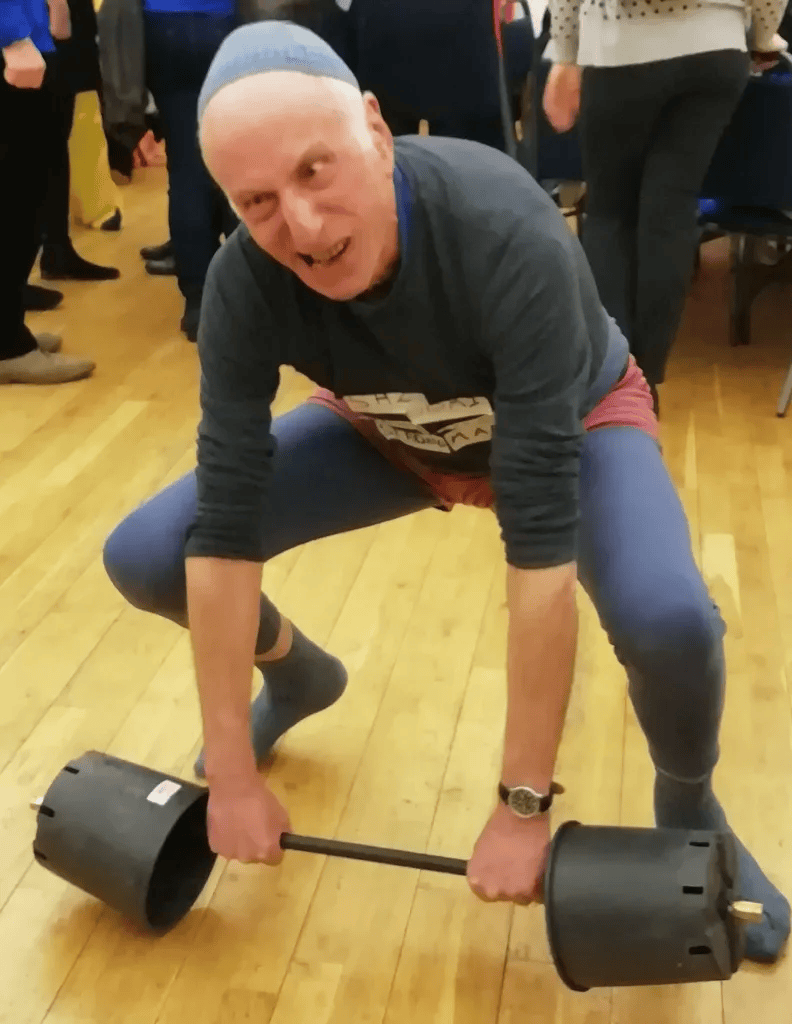
Born in 1947 to Maurice Cohen, a late returning soldier and Rachel Finestein, a wartime volunteer St John’s Ambulance nurse. The parent, along with his love, Sonia, née Rodkoff, of two children, Malcolm and Adam, each remarkable in their own way. A man who has fallen short occasionally, though one who has never allowed setbacks to define him.
The pieces below are roughly chronological in terms of my life and the lives of other family members.They represent a mixture of published and unpublished work.
You can reach out to me at lawrence1947cohen@gmail.com
The friends who cared
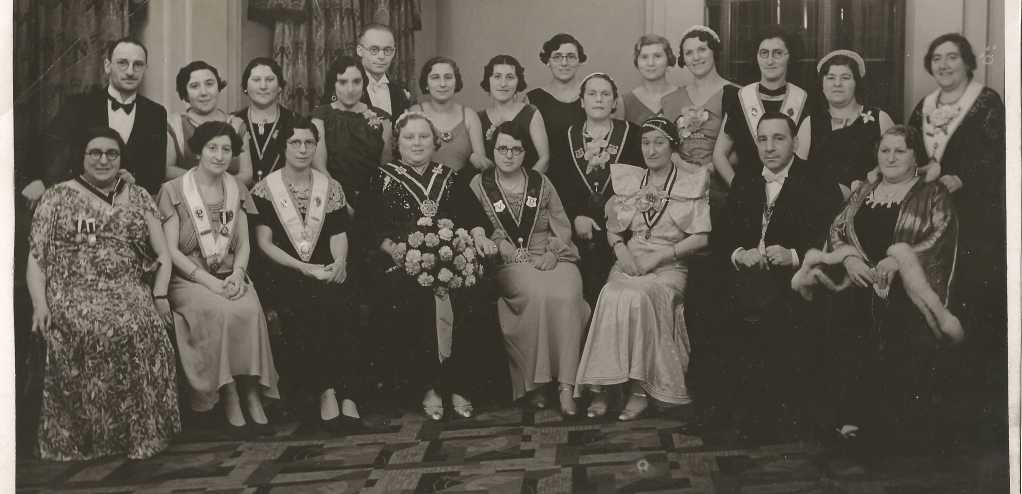
Let us take a closer look at this group photograph from the 1930’s. Nineteen young women in their 30’s and 40’s and three men smile as a photographer from the World Jewish Press Photographic Agency, headquartered in Fleet Street, clicks the shutter. The occasion is clearly a significant one: everyone is formally dressed, with a couple of tiaras and some floral adornment in evidence. The men, one or two spouses and the regulation guy from head office, are incidental to the proceedings. Seated in the front row are the movers and shakers decorated with sashes of office. Among them, the third woman on the left, bespectacled, in a black dress with a lace top, clutching a small object (an evening bag?) is my mother, Rachel Finestein. She wears the collar of her past presidency. Unlike her brothers who anglicised their name to Fenton, she would remain Finestein for another ten years or so until, at the age of 42, she was introduced to Maurice Cohen, aged 39, with whom she, later, had a child. Me.

The gathering is to celebrate some event in the calendar of the Princess of Wales Lodge No 25 (Ladies) affiliated to the order of Achei Brith (Brothers of the Covenant) and Shield of Abraham, a mutual self-help alliance of friendly societies which acted as a safety net in times of sickness before the establishment of the Welfare State. So, who are the women behind the smiles?
I can only contribute my own recollections, now fast fading, of my mother and her friends. I knew several of them as ‘aunties’, women who never married, largely due to the shortage of men after the carnage of the Great War. They were the progeny of immigrants in the East End of London, who on leaving school at the age of fourteen or thereabouts, seized the opportunity to avoid the drudgery of the garment factories by learning shorthand and typing and progressing to clerical work. My mother, Rachel, was typical. She joined a City company, newly qualified, in May 1918 and only retired from the same firm in 1993 when her health began to fail. She retained her friendship with the girls from the Lodge throughout her life. A memory of my childhood is being taken to tea with her pals at the Regent Palace Hotel off Piccadilly Circus in the mid 1950’s. Very posh, although the orchestra and the cucumber sandwiches impressed me less than the marble urinals in the basement.
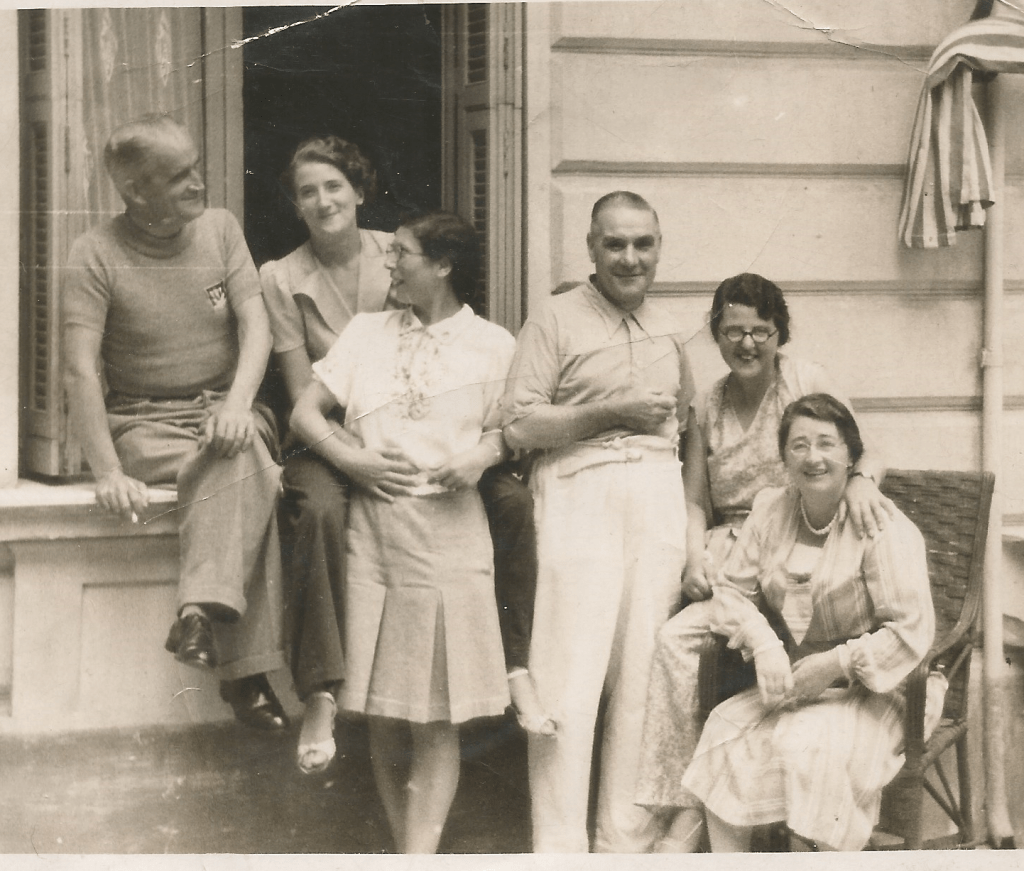
As young unmarried women with a degree of financial independence, they also went on holidays abroad, unimaginable to the majority of East Enders: Norwegian Fjords, an excursion down the Rhine. Another photo, with an inscription in French on the back shows Rachel and her friend, Sarah Harris, posing in an entente cordiale with some Gallic chums, looking like they are having the time of their lives.
By contrast, running the Lodge was a serious undertaking. The friendly society depended on the scrupulous honesty of its elected honorary officers in collecting subscriptions and distributing benefits to members in times of sickness and financial need. Socially, the Lodge also played a huge part in the lives of these women. And they were not uninvolved in the febrile political atmosphere of the 1930’s either. My mother described to me how she was delegated to take shorthand notes at an anti-fascist meeting – just in case there was a Metropolitan Police undercover agent present who might present a false account of the proceedings to his superiors.
Devoted to duty, Rachel, like her friends, took her quiet, unassailable spirit into wartime. Holding down her clerical job by day, by night she was a volunteer St John Ambulance nurse in the London Hospital in the heart of the East End. She always claimed that being selected to march in the St John contingent in the 1946 Victory Parade was reward for her efforts in collecting donations around the East End tenements. But I have my doubts.
Researching this article in a publication of the Jewish Historical Society[1], I made a discovery which brought tears to my eyes: a photograph of her own Presidential Collar, the one which she is seen wearing in the group photograph, identified in the archives of the United Jewish Friendly Society[2] as: ‘worn by sister R Finestein 1933-4’. She would have been delighted to know that her badge of office was preserved on the internet for posterity.
Remarkable women, living in a remarkable era, whose sense of community and regard for each other ensured that life would still be liveable even in the hardest of times.
[1] See: The Jewish Friendly Societies of London 1793-1993. R P Kalman and Raymond Kalman. Included in Jewish Historical Studies Vol 33.
[2] The archives of the United Jewish Friendly Society and its predecessors are held by the University of Southampton
https://www.thejc.com/family-and-education/all/the-friends-who-cared-1.505797
Dear Dad …… Your Father’s Day letters

In my mind’s eye I see you, sitting on the ledge smiling in at me, three floors above the traffic that runs along Green Lanes, Harringay, roll-up dangling from your lip, window frame on your knees, polishing the glass with a damp shmattah, enjoying a smoke on one of those regular early 1950s days between being demobbed and dying.
“I’m all right son, I won’t fall.”
I found this photo (“10/9/45 – Germany – Morrie) today in your box among the medal ribbons, shaving brushes and the testimonial from the commanding officer of 860 Laundry Bath Platoon: “… in sole charge of a Bath House with a small German Staff.” Why are you smiling, Dad? Because you’re going home soon, back to your mum (I shuffle the stones on her grave every year when I visit yours)? Or because you just like keeping things clean?
Give me a sign, Dad, come to me in a dream, smile at me through a window. You’ve been gone 53 years; time is pushing on, the water needs changing and the Staff wants to get home.
Lawrence
https://www.theguardian.com/lifeandstyle/2011/jun/18/your-fathers-day-letters
A tribute to Solly, lost but in our hearts
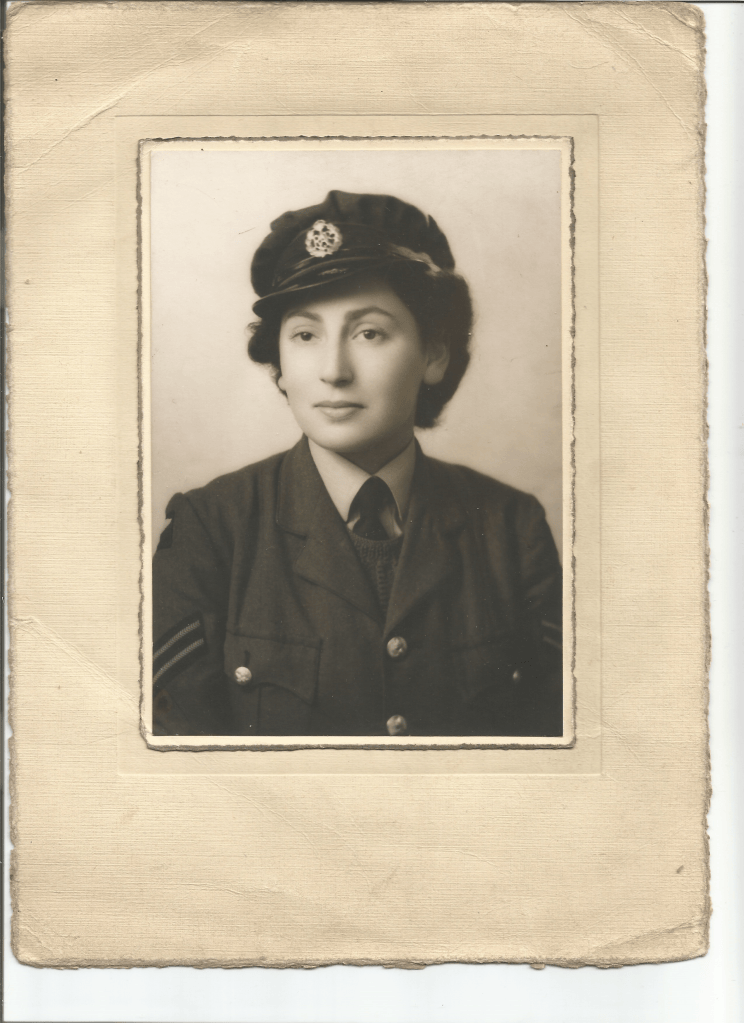
A yellowing page torn from the JC of July 16th 1943 lists the casualties; those killed in action and on active service, the wounded, the missing and the prisoners of war. At the foot of the page there is a photo of my cousin, Sylvia, Corporal S Fenton, from the Mile End Road in the uniform of the Women’s Auxiliary Air Force who has been Mentioned in Dispatches and listed in the King’s Birthday Honours. Seventy years later I interviewed Sylvia and recorded her remarkable story on video, so her great grandchildren should know her, now that she too has passed.
But what of the fallen? For those us born to the survivors, there are no memories, only names, mentioned in passing at Seder tables, or images in a family album. We never knew them, and even those who did; they are getting fewer and frailer with each year that passes. How to honour the Jews who served in the British armed forces and were lost? Here is one story for Remembrance Day, pieced together from recollections of a fast receding past, from a letter, from a photograph, from a visit to a grave, and, more recently, from an internet search.
At a hearing convened by the London Beth Din at the end of World War Two, a man and a woman come before a rabbinic court to perform the ritual of halitzah. The man testifies that he is not willing to take the childless widow of his deceased brother for his wife. In response, the woman removes the shoe from the man’s left foot, spits into it and makes the declaration: thus shall be done to the man who will not build up his brother’s house. She is now free to marry whom she chooses.In reality, the hearing is a formality; the man already has a wife and a child of his own and there is another on the way.
The man is my father-in-law to be, Myer Rodkoff. The woman is Sally, nee Sarah Bloom, the widow of Soloman Rodkoff. In the year that marks the 75th anniversary of his death, in Normandy on 7 Tammuz 5704, on 28 June 1944, this is his tribute.
According to his sister, Rene, Solly was a spieler, a gambler, thrown out of the family’s Jubilee Street tenement by his father, on more than one occasion. Though Rene and her siblings were born and raised in poverty, the good name of the family was at stake and Solly was only readmitted on his promise to take up a respectable trade. But even a wife couldn’t keep him at home when the call came to join the fight against Fascism. Enlisting, as a volunteer, rather than waiting to be conscripted, Solly, now Rifleman Rodkoff, was assigned to the sharp end of the Allied invasion force: 8th Rifle Brigade, part of the 11th Armoured Division, charged with leading the break-out from the D Day Normandy beaches.
We can never know, precisely, the circumstances of Solly’s death. A letter from the Senior Jewish Chaplain, Second Army, dated 30th August 1944, provides some details; a small measure of comfort to his grieving parents:
Dear Mr and Mrs Rodkoff
…….. First of all, let me express to you my heartfelt condolences and deepest sympathy in this tragic loss which you have been called upon to bear. I can only pray that the knowledge that he died at the Front, in the cause of the Liberation of Europe and of our people, will help to assuage your keen sorrow.
Your son’s death affected the whole unit deeply. In the morning he had an amazing escape, a shell hitting his vehicle and passing through the engine, without touching him. He was congratulated on all sides at his good fortune, and in the afternoon he was wounded and evacuated. It was not realized how seriously wounded he was by his unit, but he died the same day at the Field Ambulance and was buried by the chaplain to the 2nd Fife and Forfar Yeomanry who was present.
I received all these particulars from his unit, when I visited it at Myer’s request, and I can therefore speak directly of the great esteem in which he was held by his unit, as a fearless and gallant soldier, and a good comrade.
May the Almighty send you His Comfort and Consolation ……
According to a memoir[1] by a fellow soldier, it was German Tiger Tanks which caused heavy casualties among 13 Platoon; four men were killed, including Solly, and there were numerous wounded in the fight to throw the enemy off of Hill 112, soon to become a killing field for an entire British division.
Coincidentally[2] I discover that Solly was nick-named Russia by his comrades; a recognition of his parentage and the respect which the British squaddies had for the Red Army which was winning the war in the east. In fact, the Rodkoffs were from the Ukrainian town of Kamenetz Podolsk; they just fancied themselves as Russians.
Solly’s death was not the only tribulation suffered by his family in 1944. In October, Solly’s half-sister, Bessie, was killed along with her husband and son in a V2 missile attack on London. For them there is no memorial; only entries in the registers of birth, marriage and death.
It wasn’t until the late 1980’s that we found Solly. Together with my wife, Solly’s niece, and our two young children, we drove the A413 from Caen to the Banneville-La-Campagne British military cemetery. There, in the furthest row, lies Solly. A photograph taken shortly after his internment shows a temporary memorial; a wooden Magen David bearing his name, rank and number, the initials KA (killed in action) and the date of his death. Now a standard Commonwealth War Graves Commission headstone marks his last resting place.
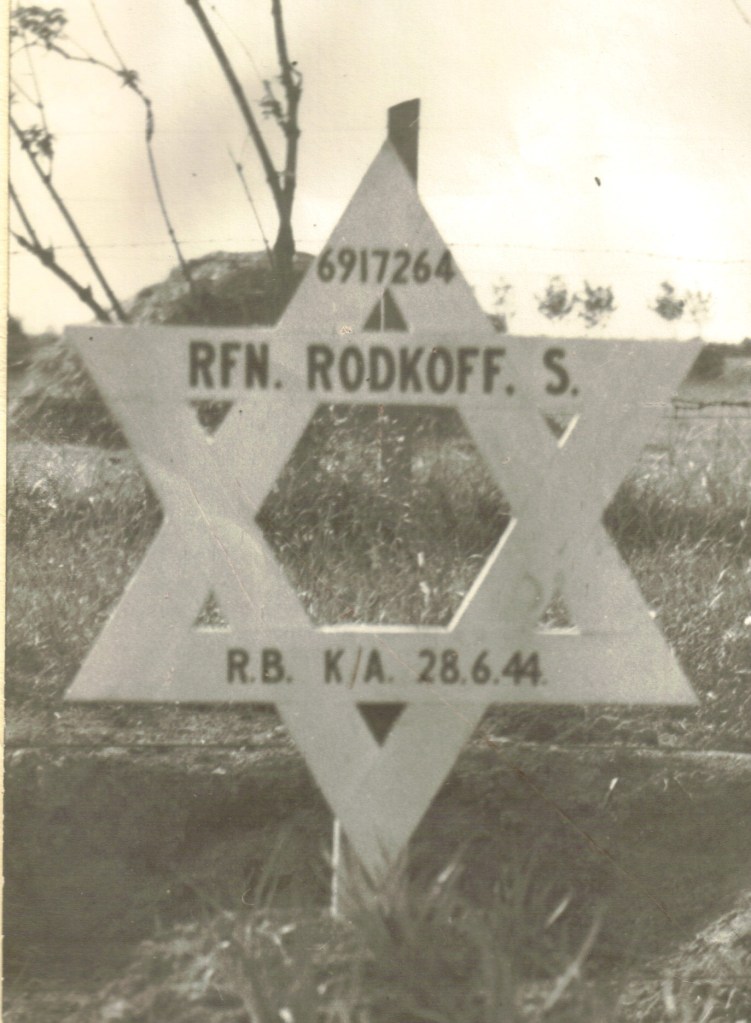
Among the fallen, there is a scattering of other Jewish graves: Cyril Litwak, Emanuel Mossack, Mendle Rottman, Vitalis Weingreen, Anthony Ekstein, Harry Garfunkle, Joseph Abrahams, Arthur Marks. They served in units ranging from the Royal Armoured Corps to the Queen’s Own Cameron Highlanders. They hailed from a variety of locations: Manchester, Hull, the London contingent from Bow, Dalston, Mile End and the Upper Clapton Road.
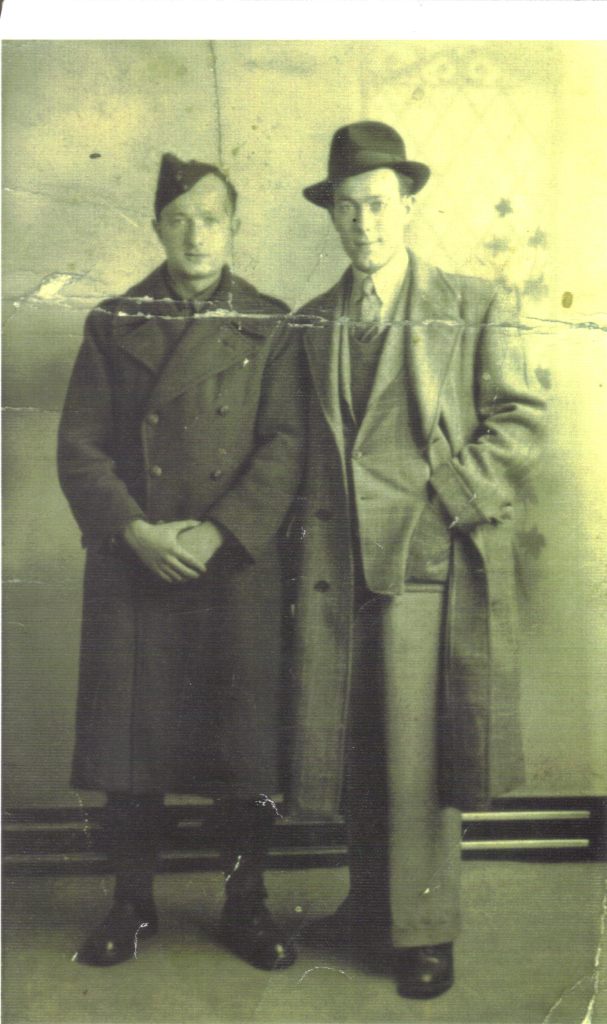
Of Solly, little remains apart from the stone; an entry in the cemetery records, a photograph of him in uniform taken with his brother Myer, a letter of consolation. There should have been a child: you see his widow, Sally, who spat in the shoe of her brother-in-law, to manifest her contempt at his refusal to build up his brother’s house, was pregnant at the time of her husband’s death, but she miscarried and the families lost touch.
My guess is that the halitzah ceremony weighed heavily on Myer. He had failed to talk his younger brother out of enlisting in the infantry; cannon fodder in his own words. So, when in the following year a girl was born to his wife, Nancy, he named his daughter Sonia. Sonia, my wife, a living memorial to her uncle Solly. On this Remembrance Day: Zichrono Livrachah; his memory for a blessing.
[1] With the Eighth Rifle Brigade from Normandy to the Baltic, Don Gillate
[2] http://ww2talk.com/index.php?threads/h-company-8th-rifle-brigade-11th-armoured-division.60217/
https://www.thejc.com/life-and-culture/all/a-tribute-to-solly-lost-but-in-our-hearts-1.494744
Of feasts, fasts and far-off Finsbury Park
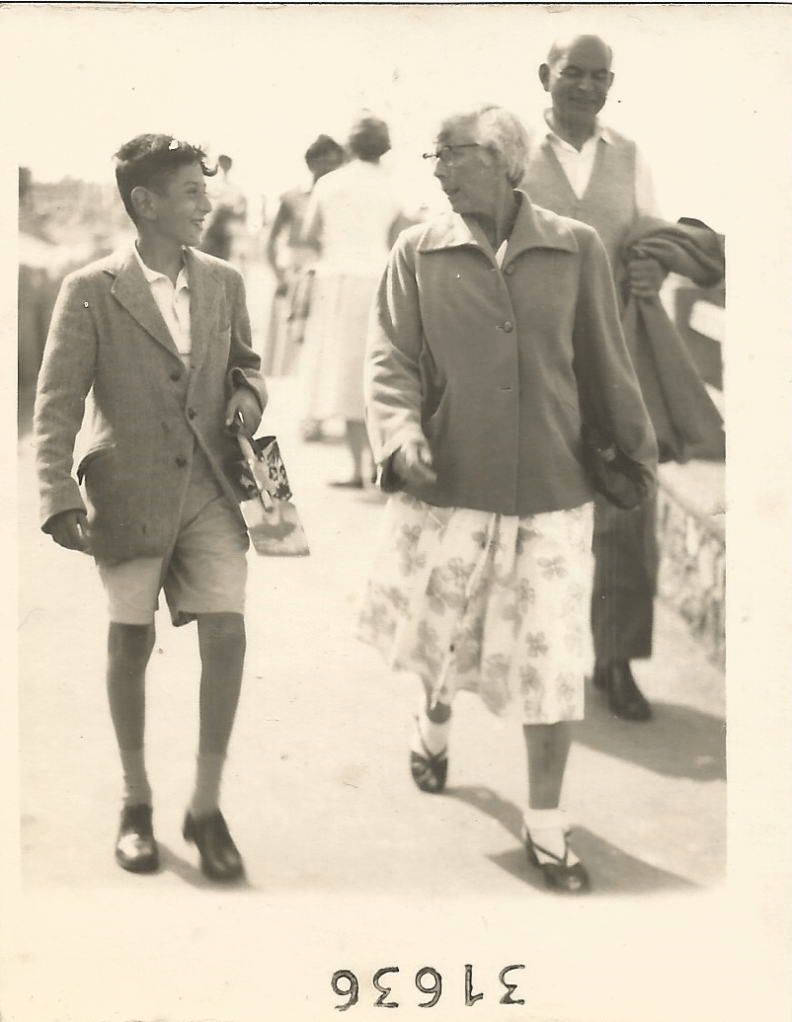
For some it’s Rehov Ben Yehuda or the Champs Elysees, for others the Nevsky Prospekt or the Unter den Linden. But for me, born 1947, the issue of a late returning soldier and a never-say-die spinster, delivered in the Royal Northern Hospital, succoured in rented rooms above an ironmongers shop in Green Lanes, Harringay, initiated some few years later into the cult of football at Highbury, the stretch of the Seven Sisters Road between Holloway Road and Manor House was the highway that linked all the meaningful locations in my early life.
Growing up as an only child in the early 1950’s, on the same latitude as Stamford Hill, but to all intents and purposes, a galaxy away, I inhabit a world of horse drawn milk carts, bomb sites and pea-souper fogs where stout aunts pull on my cheeks as a sign of affection leaving my eyes watering with pain. I am able to work out for myself that Kanine a Horror are words of endearment rather than a curse on a rabid dog, but often adults say things which leave me confused and speechless.
“Lawrence, tell us about your Feasts and Fasts.” Forty-one pairs of English and Cypriot eyes turn on the only Jewish child in the class at South Harringay Junior School. At the age of seven I am having difficulty working out what I am supposed to say. Miss Diprose, sensitive to my bewilderment, attempts to tease an answer out of me: “I mean, do you have a Fast and then a Feast,” she smiles encouragingly, “Or is it the other way round?”
I know for a fact that the adults in my family fast on one day a year (not my dad; religion has somehow passed him by) but, as far as I am concerned, feasts exist only in the pages of Billy Bunter stories where Billy and his public school chums hold midnight feasts in the dormitories of Grey Friars School. I have no idea what she is talking about. Miss Diprose moves tactfully on. But I feel that I have let her down.
If Feasts are part of being Jewish, why hasn’t anyone mentioned them at Cheder? I try to fathom this mystery as the 29 bus carries me along Seven Sisters Road to the Cheder in Finsbury Park where I learn to read Hebrew from a primer called Rashis Daas.
Somehow, I have forgotten, my cupple, my head covering. Before I can ask him about Feasts my teacher waves me in the direction of the head teacher’s office where a group of senior students are being taught. I knock and enter: “I haven’t got a cupple”.
The head teacher looks round at his group, smiles and turns to me. “No cupple? What shall we put on his head – a boot?” The seniors all now turn to smile at me. What an ignoramus, their looks seem to say, don’t you know to bring a cupple to Cheder? Don’t you know that the Christians call our Paysach, Shavuous and Succos Feasts, that Paysach follows the Fast of the First Born, and the Fast of Esther precedes Purim, but otherwise there is no correlation?
I shuffle about on the spot for a minute, unsure of what to do next as they have gone on with their lesson and as no one is paying me any attention anyway, unnoticed, I slip out of the room. I can’t return to my class bare headed, so I walk back up Blackstock Road to the Seven Sisters Road and get the bus home.
Night is falling. On an otherwise deserted upper deck of a Number 29 a man asks me if I like football. Nervous about remaining tight lipped with any more adults that day I say yes, which is the truthful answer, and he invites me to his house where he has a football which I can have if I am interested. Somehow we establish that the ball in question is a rugby ball and, seeing a way to decline his offer without offending him, I explain that soccer is my interest. He doesn’t seem that bothered but I stare purposefully out of the window for the rest of the journey just in case.
My Auntie Celie – not my real aunt: we share rooms with her and her family – on the other hand is incandescent: “Why did you come back early?” I don’t have the words to explain. “Just wait till your mother gets back from work,” she mutters darkly.
I wait apprehensively but there is no telling off from my mum and, as nobody mentions it at Cheder the next time I go, I feel that I have got off lightly.
At the other end of the Seven Sisters Road is my Auntie’s Ladies Foundation shop – Goodhardt of 518 Holloway Road – where I go at least once a week, usually on a Saturday, with my mum to visit her older sister, Yetta. A few doors away stands the Royal Northern Hospital where I entered the world. The nurses who patronise my aunt’s shop speak the dialects of the 32 Irish counties and despite the daily routine of dealing with death, none of them would dream of speaking of the dead without appending a God Rest His Soul to the name of the deceased.
Sat in the parlour drafting designs for warships on an endless supply of flattened nylon stocking boxes (each pair comes in its own slim, stiff, cardboard container), I listen with one ear as Yetta and my mum gossip on the other side of the curtain that separates shop from home: “Manny, God Dressed His Soul, would have been disgusted!”
Laying aside my blueprint for a battleship that will be the pride of the Royal Navy in the next war, I try to work out what soul dressing consists of. The Window Dresser would appear to hold the key. Every so often he materializes at my Auntie’s and, stripping the displays bare, begins the elaborate process (in his socks) of creating a fresh and even more enticing montage of brassieres, girdles, corsets, slips and nylon stockings, replete with price tags and product labels. The act of correcting a minor fault after the main work has been accomplished is a trial of nerve and balance worthy of crossing Niagara Falls on a tightrope.
In a flash of enlightenment I perceive that souls are kitted out in some celestial Savile Row by the Divine Window Dresser in preparation for their passage into the shop of heaven.
In Auntie’s Irish/Yiddish lexicon for speaking about the deceased, Manny, God Dressed His Soul has to compete with Manny, Over Show Lem (Alav HaShalom: Peace Be Upon Him). This is less impenetrable. For Manny, the Show is indeed Over. But who or what is Lem apart from a character in the children’s radio serial, Journey into Space? (“Lemmie, Lemmie, are you there?” asks an anxious Dan Dare over the walkie-talkie into the infinite silence of space, the hairs bristling on the back of my neck while I shiver in anticipation of next week’s episode.)
Anyway, Auntie Yetta is a great one for peppering her speech with references to the divine as she supervises her ladies hosiery universe: Thank God, Please God, God Forbid! (either literally: God forbid it will rain this afternoon, or sarcastically; God forbid he should remember to phone his mother occasionally) and the one that I particularly admire: If the Almighty spares me….. .
Auntie always utters this in a tone that suggests that, although she is prepared to submit to the Divine Will, if the worst comes to the worst, the Angel of Death will know that he has been in a fight. “If the Almighty spares me I’ll be at my granddaughter’s Chupah.” No contest. What Deity worth His salt would fail to give the nod to Auntie Yetta, if only on points? Not only is she at the Chupah (Wedding) but the Angel prudently stays his hand long enough for her to rejoice in the birth of her great grandchildren, Kanine a Horror.
Now that world has been swept away. The Seven Sisters Road still runs majestically through North London but the Almighty has taken to Himself both my aunt, my mother, and the Irish nurses at the Royal Northern hospital, itself absorbed into the Whittington. He has dressed the souls of Miss Diprose who was doubtless mortified that she had embarrassed me and the head teacher of the Finsbury Park Cheder, who was in truth a kindly man. He has dressed the soul of the man on the bus who drew back from enticing a small child to his home. Aleihem HaShalom – Peace be upon them.
And one day, though I pray He will tarry, He will dress mine.
https://www.thejc.com/news/world/of-feasts-fasts-and-far-off-finsbury-park-1.56258
The Death of My Father
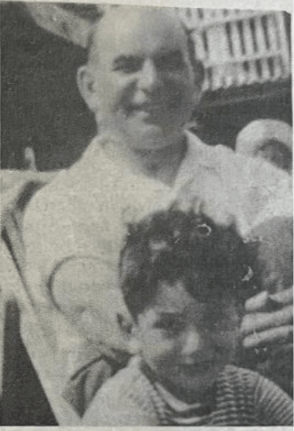
In my mind’s eye I see you, sat on the ledge smiling in at me, three floors above the traffic that runs along Green Lanes Haringey, roll-up dangling from your lip, window frame on your knees, polishing the glass with a damp shmattah, enjoying a smoke on one of those regular early 1950’s days. You’re in work, cutting smoked salmon for the clientele of Cohen’s (another Cohen, not you) Delicatessen in the Edgware Road, and there are the tips too, which, after the rent is paid, leaves enough for a two-week holiday for the three of us in a boarding house at the seaside.
Through the glass I watch as you pinch the cigarette with your thumb and second finger and move your lips to reassure me: “I’m all right son, I won’t fall.”
And you didn’t fall, did you Dad? You slogged it out in the infantry for four years until they medically downgraded you. Maybe you were cracking up and they saw it coming. You never talk about the War, do you? I desperately want you to be my hero but when I ask you what was the best thing about the army and you tell me it’s when you got a change of underwear, you can understand why I’m disappointed, can’t you? Didn’t you ever fire a Bren gun? Toss a grenade or two? How come you never shot any Germans? (We only found out later that they were Nazis.)
I found this photo (‘10/9/45 – Germany – Morrie’) in the tin box I keep, among the medal ribbons, shaving brushes and the testimonial from the commanding officer of 860 Laundry Bath Platoon: ‘…in sole charge of a Bath House with a small German Staff.’ Why are you smiling dad? Because you’re going home soon, back to your mum (I shuffle the stones on her grave too when I make my annual pilgrimage to East Ham cemetary)? Or because you just like the whole cleaning shtick? And how small was the German Staff? At six foot in your laundered socks and shoulders like a docker’s, I bet you were bigger than any of them.
Meanwhile we’ve moved to Stamford Hill. On one side the neighbours are a Belgian frum family who lost people in the Holocaust. The sound of the husband’s rants filters through the walls. On the other side are Welsh goyim, a grandmother, a daughter and a grandson. The boy doesn’t have a father; he never came back from the war. My father, the mensch, takes the boy along with us on our trips to watch Arsenal pay football. And we do laugh a lot when you tell Mum we are going to the park, and we end up at the cinema.
In 1957 after you don’t feel well on our two-week seaside break in Weston Super Mare, they take you into Hackney Hospital but before the turn of the year the doctors have decided they can’t do anything more for you and they send you home in your pajamas and dressing gown and you spend the remaining few weeks of your life in bed, in pain. And the last time I can be sure I see you is the morning of the day I take my 11 plus exam in January 1958. Two days later, in the evening, you are gasping out your life. Mum tells me to run round to Dr Rosenthal, three streets away, and ask him to come as soon as possible as Dad is very ill. We don’t have a phone and although there is one by the parade of shops in Dunsmure Road, it’s more reliable to send me. Or maybe she just wants me out of the house.
Getting home, I shut my ears to the sound of you dying in the bedroom two floors above the kitchen where I sit reading Tom Brown’s Schooldays. An uncle and aunt arrive to keep me company, but they merely whisper to each other, so I go on reading. Gradually your gasps grow weaker, until the house falls silent, and Dr Rosenthal departs and then the uncle and aunt depart. And then my mother descends to the kitchen and sits down by my side and gives me the news which I have been careful not to anticipate. On cue, I burst into tears. That night, she and I occupy the single bed in the room adjoining hers. Sleeping alongside the corpse of her husband is not an option.
The next day, I hand a note to my teacher, Miss Marigold, telling her that I will be off school for a week, and I scurry back to my desk while she reads it. And people come to our house who sit and talk to my mother and cast surreptitious glances in my direction.
But there’s one thing I can do Dad, which you never could, because you never went to cheder or had a bar mitzvah; I can read Hebrew. And it’s just my good fortune that at the New Synagogue, Egerton Road there is a youth minyan, full of boys, older than me, who know how to daven and at their head is a young rabbi, the very rabbi, as luck would have it, who is my cheder teacher. And although I’m only 10, I am uniquely qualified; I am the only mourner amongst them and my duty and privilege is to recite Kaddish every Shabbos.
Except that it turns out that I’m not up it. The young rabbi summons me one evening at cheder and tells me I’m a disgrace and my Hebrew reading is a disgrace, and I should stand outside the class and practice, and only return to the classroom when I am competent.
So, I stand in the corridor, weeping bitter tears of shame. On the walls are mounted photographs of previous generations of cheder pupils. Without exception they look down on me. ‘Ignoramus’ is their verdict, can’t even recite the mourners’ prayer for his own father.’ And it’s your fault, Dad; if you hadn’t gone and died, I wouldn’t be standing here now, would I?
Give me a sign Dad, come to me in a dream, smile at me through the window. You’ve been sitting on that ledge, puffing on the same smoke, for nigh on 70 years. Time is pushing on, the water needs changing and outside, in Green Lanes, evening is drawing in. There’s a chill in the air, and I’m beginning to feel the cold.
Of Fights, Fringes, Fires and Fumbles on the Fore deck
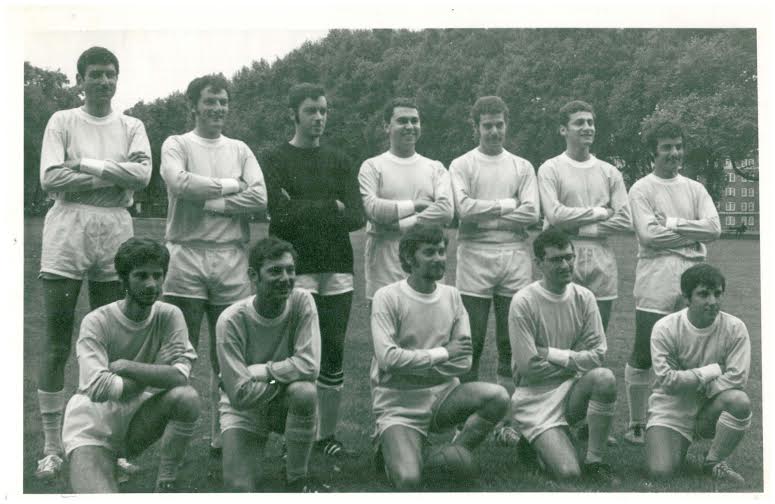
Recently, a group of nine Grocers’ old boys, including myself, have started meeting for lunch every three months to reminisce over those heady days nigh on 70 years ago when we were all novices at the school dubbed ‘The Jewish Eton’. Our recollections are many and varied. Here are a few of mine.
“He probably only just scraped through,” says my Uncle Jack on hearing of my success in the 11 Plus exam. It’s June 1958 and I am being grilled by Vernon Barkway Pye, headmaster of Hackney Downs Grammar School (popularly known as Grocers), who asks me what books I have read. I practically live in the Stamford Hill public library but can’t recall a single title apart from Biggles Flies East. Still, a letter arrives a few days later saying I have been accepted.
“Laurence Cohen,” calls out Mr Vaughan (maths) as the new first year pupils assemble in the forecourt waiting to be allocated to their classes. I step forward. So does another, smaller boy. “Who are you?” enquires the maths man. “Lawrence Cohen,” I say, sensing the beginnings of an identity crisis. “Do you spell Laurence with a u or a w?” “W,” I say. “Well, I called Laurence Cohen with a u,” says Vaughan dismissively,” Go back until you hear your name called.” Day one and it’s not looking good.
Actually, I’m being unfair; after a shaky start I find my natural level amongst the lower forms of life; the thoughtfully nominated Y and Z groups, in contrast to the Alpha and A classes where Harold Pinter once enjoyed a meeting of minds with the inspirational English master, Joe Brearley. And, incredibly, I manage to win a boxing match in my first year. It happens like this:
Stan Gunter, the PE teacher, partners me with a rather short sturdy lad who is broad as I am tall and skinny. We wear boxing gloves, but we don’t wear head guards so being hit repeatedly around the head gives me a keen sense of the way that my brain floats around inside my cranium. I’m all flailing arms and he is all clubbing fists, but somehow Stan gives me the decision.
The next year I’m paired with same lad again. I race out of my corner, a dervish on Benzedrine, but this time he pummels me almost senseless. Stan asks me if I want to carry on. I nod dumbly, like a prisoner being offered a blindfold before execution, hoping it will soon be over. And it is: Stan stops the fight a few seconds later.
By the way, come the summer term, Grocers’ boys used to swim without trunks to avoid polluting the school swimming pool (so they told us). Our dads have omitted to mention that naked pubescent boys are prone to engage in mild homoerotic behaviour. Fortunately, us Jewish lads all wear Tzitzith, fringed undergarments, which go some way to sublimate the Evil Inclination.
It also helps that the school production of Shakespeare’s The Winter’s Tale entertains applications for the female roles from the local girls-only grammar: John Howard. We can stop fooling around with each other and, feigning an interest in Elizabethan drama, start exploring the possibilities of a mutually consensual grope with a Perdita or Hermione. But a fault in the electrical wiring intervenes and Hackney Downs School is incinerated. The magnificent amphitheatre, the venue for the production, where Pinter once played Romeo, burns to the ground in 1963, along with the top floor of the main building. The Evening Standard, rather insensitively, publishes a group photograph of cheering schoolboys.
The School is broken up, and its denizens, are sent into exile. Years one to three are billeted in the Victoria Jewish Youth Club in Stamford Hill. We older ones find ourselves in a barren waste land, a Secondary Modern in Central Hackney reserved for the most lumpen amongst the proletariat. The Grammar School boys, Christian and Jew alike, fear for their safety – but a saviour is at hand, and a Jewish one at that. Bob Z has words with the local hard men, and we are not discomforted.
In this Hackney version of the Purim story, I even have a small speaking part:
One Who Rises Up In Every Generation To Smite Us: “Do you know a kid called Z…..?”
Lawrence with a ‘W’: “Er, yes.”
OWRUIEGTSU: “Tell him we want to see him outside at break.”
Lawrence with a ‘W’: “Er, alright.”
As it happens, many of us identify strongly with the proletariat, although we get a bit panicky when we find ourselves alone with any of them, especially in Mare Street after the pubs have shut. So, it’s no wonder that once we return to our fire-scarred Hackney Downs site, Labour is narrowly returned as the boys’ choice in the mock vote, in line with the actual result of the 1964 General Election. And I am the Labour candidate! I have triumphed and am congratulated (through gritted teeth) by Mr Williams, the successor to Barkway Pye, in School Assembly. My fifteen minutes of fame have arrived.
But nothing compares to the fifteen minutes I spend after sundown with Laraine, a golden-haired girl from Plymouth, on the fore deck of the Devonia, a converted troop ship, which ferries parties of school kids around the Baltic on so called ‘Educational’ Cruises. What does she see in me, a lanky fifteen-year-old in with near terminal acne? Really, I don’t have the answer. So, Laraine, if you are out there….
In our final year, 1965, I am convinced that our crusty Economics teacher, L J Marr, is more generous in his assessment of certain boys’ work. There is only one way to find out: I copy out an essay of Alan K’s word for word and submit it as my own. He gets B minus; I get C plus. Vindication! Sadly, Marr knows a bit more about us than I give him credit for: Alan K is awarded a place at Cambridge whilst all my university applications are rejected, apart from Bradford Poly which puts me on its waiting list.
Still, I am not disheartened, my seven years at Grocers have not been a complete waste: I have won a fight, I have snogged a girl (admittedly, not on site) and I have played a small part in the struggle to establish socialism in this green and pleasant land.
And some decades later, when the distinguished Old Boy, Lord Michael Levy, Baron Levy of Mill Hill, a near contemporary, visits the College where I earn a crust as a humble English lecturer, I contrive to bump into him, and our mutual acquaintance with the School, and its public-school style House system, is renewed – much to the chagrin of the College Senior Management Team. His lordship is ushered away, and Lawrence with a ‘w’ is left considering the vagaries of fame and fortune.
Picking up my pen I write an ode to the Grocer’s Nine. Rock on guys!
The Reunion
We are the boys of ‘58
Lined up in rows for teachers to disperse
Each to his own first-year class
On that day one at Grammar School
The reward for passing Eleven Plus
We the wood, the rest the chaff
Each head proudly adorned with cap
Emblazoned with the image of a camel
Yes, a camel!
The emblem of The Grocers’ Company
And now an elderly nonet, we Grocers Nine
Dine out from time to time
Our memories of ‘58 still sharp
Though a mite befuddled
Over which of us ordered whitebait
To whom belongs the carp.
Collecting Holy Things
The Yiddish writer, Israel Leib Peretz, spins the tale of a soul whose admittance to the World to Come is conditional on returning to this world and locating objects of religious interest which will resolve a dilemma of heaven’s own making. You see, the scales determining the soul’s fate are so finely balanced between its good deeds and its misdemeanors that the heavenly court is unable to reach a decision on the soul’s eternal destination: Gan Eden or Gehenna; heaven or hell. Inevitably, there is a queue, and the administering angels are under pressure. Rather than take up more heavenly time, the soul is dispatched to garner evidence, in the shape of three gifts, which will tilt the scales in its favour.
The neshamah, the soul, flies hither and thither in its search and, over a span of years, collects the items that, hopefully, will realize its salvation: some grains of soil from the Land of Israel, a common pin of the sort that women used to secure their hats to their hair with, and a kippah. Each object bloodied by the martyrdom of a Jewish woman or man for the sake of their faith. One by one the items are presented on high and accepted, and the soul is permitted to enter the gate of heaven.
I, too, am a collector of holy things. Not, you can be assured, relics of martyrdom: that would be too grisly. Rather, humble offerings which could be tendered as unsolicited gifts, if (heaven forfend!) I were to find myself in a predicament akin to that of the soul in Peretz’s story.
My first submission would be a yellowing page torn from the Jewish Chronicle of July 16th, 1943. At the foot of the page there is a photo of my cousin, Sylvia, Corporal S Fenton, from the Mile End Road, in the uniform of the Women’s Auxiliary Air Force who has been Mentioned in Dispatches and listed in the King’s Birthday Honours. Sylvia only joined the forces because, in her own words, ‘life in the East End was so bloody boring’, but her logistical work on bomb loads in Bomber Command helped lay the foundation of an Allied victory which, together with the resultant liberation of the survivors of the Shoah from the camps, merits her a degree of holiness on a par with that of a Tsaddik. Sylvia died a few years ago, aged 97, her resilient spirit unbroken. She would have had no problem gaining admittance at the pearly gates. And her experience of logistics, doubtless, has been put to good use in the day-to-day administration of heaven.
Growing up in Stamford Hill, most of the boys I was friendly with came from families who were not especially observant. Sure, we went to cheder during the week and shul on Shabbos, but we also found our way to Arsenal or Tottenham on Saturday afternoon. However, there was one family who were noted for their frumkeit, though, it must be said, their sons, who attended the same secular school as the rest of us, never behaved as though they were a cut above us. It so happened that the father of this family took a bus to and from work – in the nineteen fifties who could afford a car? During the winter months, when Shabbos came in early, he did not always get home before dusk. Now, what I witnessed was this: at the time his bus was due, his wife would be waiting for him at the bus stop. As he alighted, they embraced and walked home arm in arm as darkness enveloped them. For the wife, even the Sabbath had to concede to her sense that her rightful place was with her man. If anyone was to condemn her husband for breaking the sanctity of the day, let them condemn her too. Stooping, I retrieve the discarded bus ticket: my second gift.
Languishing in the bottom drawer of my desk is a photograph of a 1930’s group of smartly dressed youngish Jewish women, stalwarts of the Princess of Wales Lodge Number 25, a friendly society whose raison d’etre in those far off pre-welfare state days was to provide support in times of sickness and unemployment to its members. Seated in the front row are the movers and shakers adorned with sashes of office. Among them, the third woman on the left, bespectacled, in a black dress with a lace top, is my mother, Rachel Finestein. She wears the collar of her past presidency. The friendly society depended on the scrupulous honesty of its elected honorary officers in collecting subscriptions and distributing benefits to those in need. My mother donated her presidential collar to the archive of the United Jewish Friendly Society where it remains to this day in storage at the University of Southampton. As an invisible soul, I would have little trouble gaining access and filching the artefact for the purpose of my supplication of the heavenly tribunal. The third gift to be presented on High.
A page from the JC, a discarded bus ticket, a presidential collar. Armed with my holy gifts, my preparations are complete. Maybe they won’t be necessary, and my soul will attain its seat in paradise on its own merits. But, in the event of the scales being hung, the verdict handed down to Peretz’s fictional soul would suffice: ‘Truly beautiful gifts, unusually beautiful. …… They have no practical value, no use at all, but as far as beauty is concerned – unusual’.
Young Love
How does Jewish boy meet Jewish girl? Difficult one. Mandy and I were enrolled on different courses at City of London College in the mid-1960s where there was no Jewish Society. We might have met through casual contact in the canteen, or through mutual acquaintances. Hard to know one way or the other. But, for the best part of a year, we were an item. She was in London doing a secretarial course. I was studying for a degree whilst commuting from home.
She shared a flat with a couple of girlfriends over a shop in George Street just off Baker Street where I was a weekend visitor, permitted to share Mandy’s room once every couple of weeks.
The only photograph I have of Mandy is her in a group of human chess pieces, would you believe. I was the student union Charity Week chief at that time, and one of the highlights of the week was a human chess match in Finsbury Square which I organised with our friends playing the roles of knights, bishops and rooks etc. The girls created the costumes, and the blokes painted the black squares. A photograph our chess game, taken from high up in one of the offices that surrounded the square, made the front page of The Sun newspaper.
Mandy was pretty: she had thick auburn hair which flicked up at her shoulders, slightly crooked teeth, a generous smile and dark eyes that sparkled. With curves in all the right places. Her father was a Polish Jew who had seen active service as a member of the Polish armed forces. After the war he and his wife had farmed in Somerset: hence Mandy’s West Country burr. If I remember rightly, she called me sweetie.
Truth be told, ours was a good friendship rather than a passionate love affair. It was my mistake to fail to see the relationship for what it was. Friendship was something between you and mates of your own gender, wasn’t it? Foolishly, I told her that I didn’t see our future together. There were tears and then I took Mandy out for dinner to say I was sorry. I also remember going with her to a store to choose a business suit once she graduated her course. That’s what friends do, isn’t it? And she had no trouble finding a replacement for yours truly, whereas I was left floundering in the love department.
Some years later I heard that she was married with kids and living in South London. This made me happy though it never occurred to me to get in touch. The other night I dreamt of Mandy and myself as our younger selves. Maybe I was right in believing that our relationship had run its course. But I will always be grateful to Mandy: she was my girlfriend. Young love: bittersweet. And her actual name was not ‘Mandy’: I have changed it in the unlikely event that someone reading this piece will put two and two together.
Leaving
The train now standing at platform five is the 4.50 service to Edinburgh calling at Grantham, York, Darlington, Newcastle on Tyne, Berwick on Tweed and Edinburgh Waverley.
October1969. I have purchased a one-way ticket for a rail excursion which is to deposit me in Newcastle where I am assigned by WH Smith and Son Ltd as part of its management training programme.
Leaving London would be a wrench as I had only recently reunited with some old school friends who were feeling their way into post graduate working life. We became the founders of a charity group, inventively named Kampus, whose actual raison d’etre was to attract women to our gatherings. As a bona fide organisation (ha-ha) we were entitled to enter a team of the same name in the Jewish Sunday football league. Sorry m’Lud, did I hear you say irrelevant? Please bear with me.
You see, I had met this girl, who I rather fancied, at a Kampus party in Swiss Cottage, though I had foolishly neglected to invite her out on a date. Fear of rejection? We both lived in Stamford Hill and over the High Holydays, I had contrived to bump into her on any number of occasions in Springfield Park, the High Holy Day partner-seeking venue of choice for Jewish youth.
As my impending exile crept closer, I was stricken by the thought that my opportunities to make a move were dwindling. Now, it so happened that the day of my departure was a Sunday which also coincided with the date of the last football match in which I would be able to participate.
Somehow, I summoned the courage to invite the young lady to watch me play football on D Day. She readily agreed. After the match (we won 2-1 if my memory serves me correctly), she further consented to accompany me in the car, driven by a mate, on the route from Hackney Marshes to Kings Cross.
About to board the train, I asked her: ‘Can I write to you?’ She responded affirmatively. ‘Will you write back?’ Again, she signified her willingness.
Some 55 years later Sonia and I remain contentedly married.
Coming out as an LGBT dad
The signs were there early on. One Hanukah, around 1982, when the child was three or four, I bought her the best dolls house in the toyshop. After some initial curiosity it was discarded and sat gathering dust until we eventually gave it away. Later came the insistence on wearing football shorts as her foundation garment of choice, even under the pretty velvety dress she wore to her brother’s Bar Mitzvah. And she was the best at climbing ropes in her primary school.
As for me, I was happy to have a tomboy for a daughter. Going in for a tackle in an eleven a side football game (the other 21 were boys) indicated a spiritedness rather than a misplaced sense of identity. So what? The child continued to exhibit a love of furry stuffed animals and enjoyed going on play dates and sleepovers with girls. In time though, on learning from their own daughters that our child was speaking of her ambition to become a boy, the mothers put their foot down and the invitations ceased. Then did we pause to wonder.
And when the child started Secondary School there began the daily ritual, on returning home each afternoon, of changing from the compulsory girls’ uniform into boys’ clothes. But the thing about this school – Mill Hill County High – was that the teachers were understanding and most kids who went there accepted the child for who she was and there was no overt bullying, and most important of all, the child made a friend who was on his way to being gay and they were there to support each other.
But then puberty reared its head and with it came breasts and periods and while the breasts could be flattened with tightly bound bandages, the other thing led to a sorrow for the awful physical reality of her gender which left the child wailing loudly in her room, and my wife I powerless in the face of her, and our own, despair.
Gender Dysphoria. We learned the name for it on our trips to St George’s Hospital in Tooting which has a unit for young people who believe – whether by nature or nurture, we do not know – that they were born into the wrong body. So began a period of therapy for the child, initially fruitless as the she was reluctant to talk, but thereafter, with the help of a gifted therapist, progressively rewarding for her sense of self.
Eventually the time came for the young person to go to university, attending from day one as Adam, the name given to the first human creature. Of course, our Adam, unlike the one in the Bible, had to rely on the breast bandages and a regular dose of Sustanon to provide the testosterone to deepen his voice and grow hair on his cheeks.
Two years ago Adam and his partner entered into a Civil Partnership. The ceremony took place at Stoke Newington Town Hall and the reception was in a local gastro pub. The best man was the gay friend from Mill Hill County High. The bride (female) who isn’t Jewish but was working for a Synagogue at the time, and the groom (female to male) wore matching suits.
The bride’s sister flew in from New York with her Jewish boyfriend, the groom’s brother (a Reform rabbi) and sister in law, from Las Vegas. The toilets were unisex. To get to the bar you had to navigate the lesbians. So, just any other function you have ever been to!
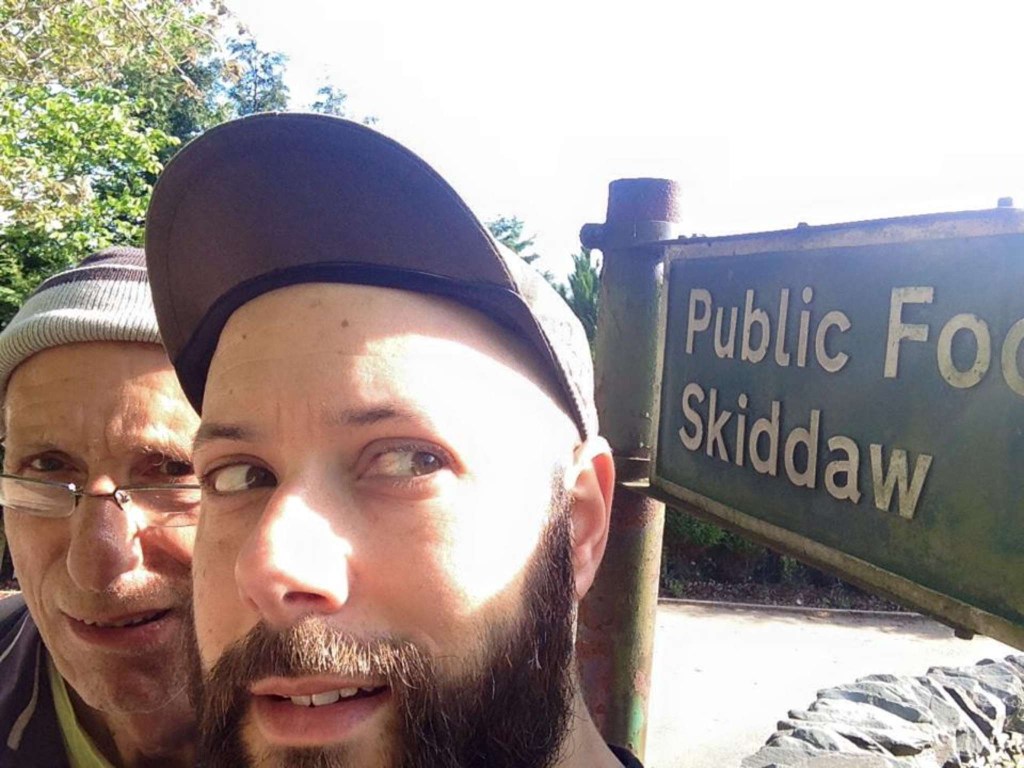
Earlier this year Adam and I did a hike in the Lake District for charity. It was first period of days we had been alone together in 20 years. I could have spoken of the pain I had once felt, but you know, we had terrific fun, him scampering over the fells, me losing my balance attempting to keep up. I may have fallen a few times but I got to my feet.
As a parent you want your kids to grow up in your image and after your likeness. Mostly it happens. Sometimes it doesn’t. And when it doesn’t you just have to make the best of it.
We were detained by Special Branch. It was my wife’s fault
Firstly, I must confess to some previous. In 1971 I was nabbed by a police motor cyclist for speeding in the vicinity of Southend-on-Sea. Some forty years later I found myself on at a speed awareness course for committing the same offence in the region of Amersham. I am a person who believes in full disclosure of past misdemeanours.
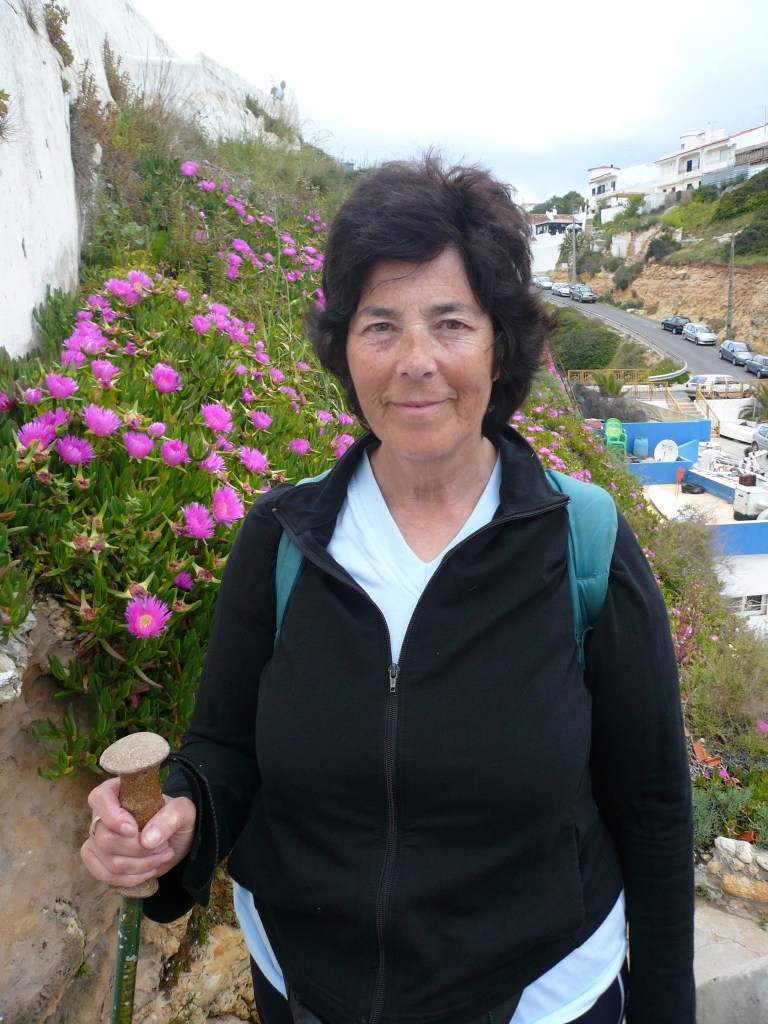
Sometime after my Amersham conviction, Sonia (my wife) and I were at Gatwick airport en route to Samos for a walking trip when one of our backpacks (my wife’s) set off an alarm on the security conveyor belt. An official asked us to step aside and requested us to open the backpack. A pair of secateurs had been detected and the official examined them with the weary eye of one who is used to discovering blades in elderly holidaymakers’ luggage.
At this point I must declare my blamelessness for what was to follow: the hand that had packed the backpack was not mine
‘I expect you are keen gardeners,’ said the official, somewhat sniffily.
Simultaneously, my wife replied, ‘yes’ and I replied, ‘no’. A little unwisely on her part considering that I am an unenthusiastic gardener, whereas she avoids outdoor work entirely.
‘Let me explain,’ I began in conciliatory mode, ‘we are not keen gardeners, but we are keen walkers, and we use secateurs to clear a way through overgrown footpaths.’
The official sighed: ‘Well, we will have to confiscate them and as a precaution we need to run your luggage through the scanner again.’
‘No problem,’ I said.
‘And I have to advise you that should the alarm sound a second time, the rules require us to advise Special Branch.’
‘We have a plane to catch,’ expostulated Sonia. My wife, bless her, does have a tendency to get people’s backs up.
‘Nevertheless,’ said the official.
The alarm duly beeped for a second time, and we were led, clasping the offending backpack, to a small room adjoining the security area.
‘Wait here,’ said the official.
In due course, a smartly dressed young man appeared. I noted that beneath his jacket there was ample room for a concealed shoulder holster.
‘My colleague tells me that you are keen walkers,’ said the officer.
‘Yes,’ I confirmed affably.
‘Have you walked recently anywhere near Salisbury Plain?
A ridiculous question. ‘No,’ we confirmed, shaking our heads.
‘As you are probably aware, Salisbury Plain is a military training area,’ continued the Special Branch man, ‘and our scanner has detected traces in your backpack of an element that is used in the manufacture of explosives.’
There flashed into my mind the fate of the Rosenbergs, Julius and Ethel, Jewish like us, electrocuted in the USA in 1953 for passing secrets to the Soviets. But wait a minute, we were innocent, weren’t we? And how could a mere scanner be relied on to distinguish a terrorist from a pair of elderly, benign travellers? There had clearly been a mix up.
‘Empty your backpack,’ said the man indicating the table at which we were seated. It was an instruction, not a request. I complied, more mystified than fearful.
What emerged, from the murky interior, was a plastic bag containing a sediment of rotting fruit left over from a countryside picnic. The price we paid for taking our rubbish home with us. I refrained from declaring that it was my wife’s tardiness which was the cause of our present discomfort.
The officer tore open the bag and ventured a sniff: ‘Probably a chemical reaction,’ he said.
I expected a rueful smile and a cheerful admonition: you got away with it this time folks. None was forthcoming.
‘Are we off the hook?’
‘You can go.’
‘And the backpack?’
‘Take it with you.’
‘Sorry for wasting your time,’ I said. He shrugged and waved my apology away. Yet, did I hear right? The imprecation ‘schmucks’ followed us out of the room as we made our way to our departure gate.
What am I doing here?
Here we go again. I arrive at Cranford Community College in Hounslow after another sleepless night in the Heathrow IBIS Budget Hotel, directly under the incoming northern flight path. It’s not the hotel’s fault I didn’t sleep; it’s because I’m on shpilches (tenterhooks). The staff see the state I’m in and offer me a complimentary breakfast to ward off the collywobbles. I take one look at the fry-up buffet and flee in panic
The college reception area is thronged with teenage candidates. Approaching my 79th birthday, I am clearly the oldest. A young Indian woman offers me her chair. I politely decline. A mum wearing a hejab (headscarf) gives me a warm smile. I smile back. In the college sports hall, the exam venue, I am the lone kippah ranger.
What am I doing at Cranford College? Ah, yes: I am scheduled to take the final Biblical Hebrew A-Level paper here. As an external student, I am unable to sit the exam at Jewish schools offering the subject. Staying overnight in Heathrow enables me to tackle the set texts from the Books of Samuel and Kings, bright eyed and bushy tailed, rather than having to navigate the trip from home through the morning rush hour. A good plan. Unfortunately, insomnia has rendered it totally obsolete.
After a year of self-study, with the aid of a collection of online and printed resources including a pristine copy of the 1954 edition of ‘A New Hebrew Grammar’ misguidedly presented to my brother-in-law Len on his Bar Mitzvah, I consider myself exam ready. So why am I putting myself through this? My son suggests I’m on an ego trip. He may be right, but it is also true that I love a challenge. Having acquired a modern Hebrew A-Level in my mid-40’s, I feel a compulsion to top it off with its biblical equivalent in my late 70’s.
Why am I telling you this? Well, my ambition is to teach this stuff. I want to share my knowledge of how this beautiful Hebrew language of ours actually works.
I have already sketched out a syllabus. This is my premise: a grasp of Biblical Hebrew can essentially be obtained from a study of Psalm 121, the one which begins: I raise my eyes to the hills.
BTW: by grasp, I do not mean the ability to translate word for word, though this would be facilitated. Rather, it is an appreciation of the style and grammar of biblical Hebrew characterized by add-ons of prefixes and suffixes around basic roots, to signify different verb tenses, prepositions and pronouns. Not forgetting the ubiquitous commencing Vav. Whew! Sounds exciting? Okay, I get it: there is unlikely to be a queue around the block on enrolment day.
Oh dear, I think I may have said too much. I received my results a few weeks ago: a ‘B’. It turns out that my knowledge of biblical Hebrew warranted at least an ‘A’. However, my essay answers in English let me down. Odd really, I was an English lecturer for the last 18 years of my working life. I’m not going to ask for a re-mark, though: I’m convinced it’s HaShem’s way of teaching me humility.
Shalom al Yisrael (peace be upon Israel)!
What I did since my cancer diagnosis.
In June 2020, on discovering that I was unable to pee, my wife, Sonia, rushed me to Barnet General Hospital where my bladder was drained via the insertion of a catheter. Indescribable relief. Having read my medical record on computer, the A&E medic who treated me, patted me on the arm and told me I was a good man. Which started alarm bells ringing. Subsequently, I was advised that I had stage 3 prostate cancer; a growth was also present in adjacent organs. The medic who performed the biopsy was also a Cohen. ‘We should meet only on simchas’, I told him. He nodded.
Age 73, I was working as an ESOL lecturer at Barnet and Southgate College. My diagnosis, and the requirement to attend hospital consultations, persuaded me to call it a day. Having got my students through their exams, I resigned at the end of the academic year.
Uncertainty about the future made it prudent to downsize. Six months into retirement we moved to a two-bedroom maisonette in Stanmore: northwest London’s premier location for distressed Jewish gentlefolk (my italics). Bonus: only 100 yards from Lidl, we were able to shop in our jim-jams.
Time to swim with dolphins? Ascend Kilimanjaro? Take a world cruise? The idea of a bucket list had no appeal. True, we treated ourselves to a trip to the USA, to attend our grandson’s bar mitzvah 2022, but otherwise our choice was to remain firmly on these shores where Sonia and I are embedded in our small world of friends and community.
Humdrum? Possibly. But contentment assumes many guises….
I got the idea of a Singing Circle from YouTube. Starting with a small nucleus of around five, we have now grown to thirty regulars. Based at our local synagogue we sing songs from the shows and the hits of yesteryear. In truth, we are the not quite good enough club; some of us have been ejected from real choirs, others have only just learned to shed their fear of singing in a public space. Thanks to a friend, who has sung with simchah bands, we have been drilled into a disciplined acapella group. My role is to prepare the programme for our weekly sessions and manage the bookings. The secret of our success? We have become a circle of friends supporting each other though widowhood, Alzheimer’s and the many other issues which beset the 70 plusses. There is real joy in what we do. Having coffee in a break from rehearsals seals the bonds of camaraderie. Dressing up for a public performance is beyond exciting.
Getting on my bike is also a great tonic. Now I am seventy-nine, my right knee is beginning to creak as I trundle my trusty two-wheeler up Stanmore Hill looking to tilt at windmills in the vicinity of Bushey Heath. I haven’t passed another rider in five years but no matter: staying in the saddle alongside motor vehicles as they overtake me is an achievement. Inevitably, ageing imposes physical limits, but most days, before breakfast, I manage to swing dumbbells, interspersed with push ups and sit ups, to limit the muscle loss which is another side effect of my drugs regime.
Having more time on my hands also enabled me to complete my novel: an on/off obsession since 2014. Anyone can be a writer; the trick is to find a literary agent who loves your work sufficiently to take you on board pending a publishing deal. Sadly, I have yet to open that email which commences Dear Mr Cohen, we at Curtis Brown were entranced by your submission…. It seems that a tale of relationships based on the Book of Ruth is a little too niche. Going down the Amazon self-publishing route was the next best option. I’m still hoping that someone in the Steven Spielberg organisation will obtain a copy and see its potential. They did Jaws. Why not Jews? They can call it anything they like once they’ve paid me for the film rights.
Joining a creative writing group at the Mosaic collective of synagogues has also been amazingly good for me. Producing a polished 500-word homework for Sue, our stern instructress in chief, is a great stimulus for my remaining brain cells.
Talking of brain cells, in the past year they’ve been bombarded with the demands of an A-Level Biblical Hebrew syllabus. Who needs another A-Level when your approaching 80? Evidently, I do. Some retirees head for Nepal. My idea of adventure was to update my Hebrew reading course: Hebrew Begins with Shalom. You can find it on Amazon. Thank you to the one anonymous person who, apart from myself, has paid good money for a copy.
Seriously, I teach my Hebrew Begins course to adults at my local synagogue where I also coach Bnei Mitzvah in the technique of leyning their Torah portions. And I fill in when a prayer leader is required for shivas. Getting too old? Naaaaa!
I have plenty of other interests to prevent me from falling into the pit of sloth and idleness. Like meeting Harvey, my friend of 70 years online for a bi-weekly chess match. Never mind that he beats me nine times out of ten. And tramping the wonderful countryside around Stanmore with a group of mates before sorting the world out over coffee is a great mood boost. Each one of us has a medical condition which would keep a lesser person at home.
Five years ago, when Sonia tripped over a paving stone and smashed her shoulder to smithereens, I slotted into the role of part-time chef and cleaner. Helping her to get her confidence back has probably been my most worthwhile achievement since my diagnosis. Thirty years of companionship on country walks has kept us strong in the face of mishaps.
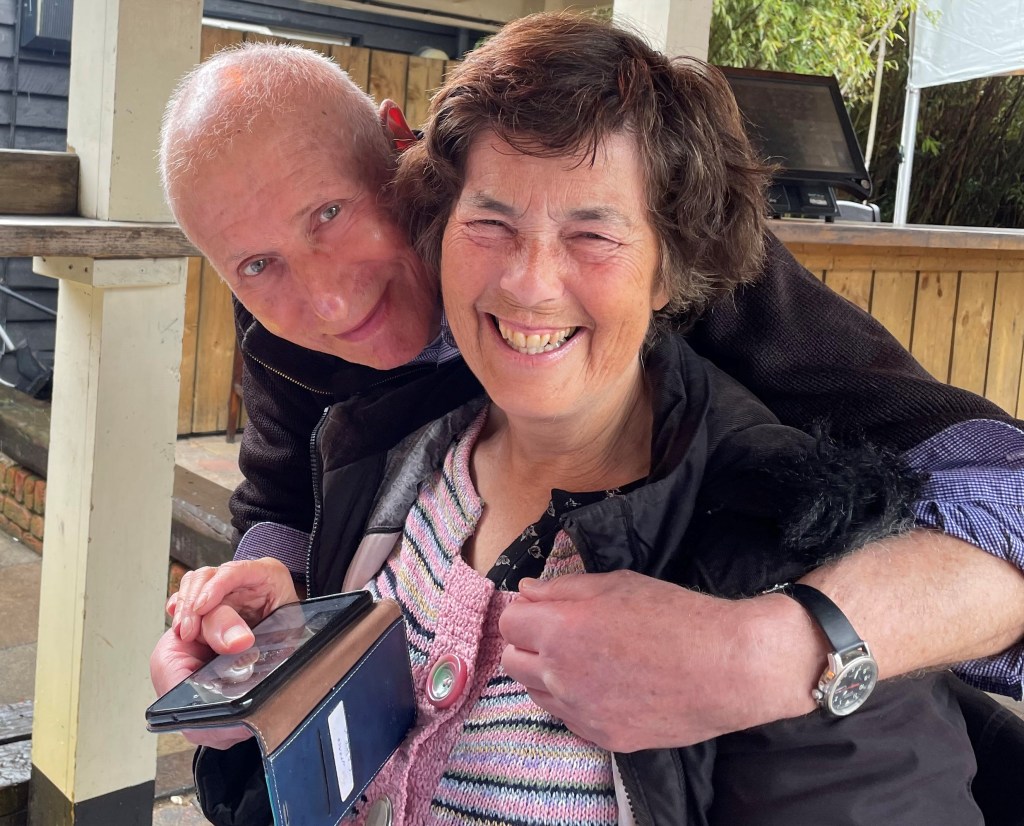
‘Oi you, wot do you think you’re doing with that coke can?’ As I patrol Stanmore Recreation Ground, litter picker in hand, in my capacity as Park Warden, I have time to reflect. Life is good. There are no guarantees that it will remain so. But making the most of it, is what we do best.
It’s My Funeral
Nothing focuses the mind on one’s own mortality like the death of a close friend and a near contemporary. When it’s our turn, with both our sons entrenched as American citizens, who will make the annual visit to shuffle the stones on the spot where my wife and I are interred?
Every autumn, in the month of Ellul, we make the trek on public transport (confession: train and bus journeys evoke a sense of pilgrimage) to stand over our parents’ plots in Rainham and East Ham to recite Kaddish. Six hours and ten changes of transport, with an interlude for a sandwich and a coffee. Inevitably, there are other graves to visit: a sister-in-law in Rainham and at East Ham an entire family, relations of my wife, buried in adjoining unmarked graves, who were wiped out in a V1 rocket attacked in 1944. Except, as we discovered, a couple of years back, a daughter survived, Lillian, who converted to Christianity, and raised her own family. Aleha shalom: peace be upon her too.
But once we are gone, there will be a dearth of visitors. We’ve talked it over and agreed on a woodland burial. The memorial masons will just have to take it on the chin; though with the glut of post war baby boomers reaching the end of their allotted spans, there should be enough work coming in to keep them busy yet a while.
Naturally, to save on cost we’ll be laid to rest on top of each other. The idea takes a bit of getting used to, but it makes complete ecological sense. Everything decomposes in the one plot; the shrouds, the grave markers, and of course, us. Instead of a slab, they can plant a tree, preferably one with the decency to shed its leaves in autumn.
The sexton took my call as the wind whistled round her in the wilds of Cheshunt. She seemed remarkably upbeat, even offering to take a card payment there and then. With prices set to rise, why the hesitation? Nevertheless, I was reluctant for the bill for our funerals to appear on the same credit card statement as the fruit and veg from Sainsburys. Despatching a cheque seemed, somehow, more appropriate.
As for the eulogies: our sons are quite capable of coming up with the salient points; my romance with Arsenal, my wife’s passion for rikudim, Israeli folk dancing. Just so long as they omit the toe-curling bit about us looking down on them. Joke: a rabbi at a funeral admits he never knew the deceased personally and invites those gathered in the prayer hall to say a few words. Silence. Desperate for someone to say something positive about the gentleman who has passed away, he repeats his request. His brother was worse calls out a voice from the back.
I got my cancer diagnosis in June 2020. The surgeon who did the biopsy was also a Cohen. On simchas, we should meet on joyous occasions, I said to him once he had finished with the scalpel. He nodded sympathetically. Thanks to the wonderful staff at the Royal Free, my condition is under control. Although I am realistic enough to appreciate that I have not been given a clean bill of health, the side effects of the drug regime I am on are a small price to pay for survival.
So, still time to select my shiva playlist.
Scrolling through YouTube, I discovered the perfect piece for my final farewell: Shir Shel Yom Chulin: A Poem for a Weekday,[1] words by Rachel Shapira. The Odelyah Berlin performance is hauntingly atmospheric: the voices phrase the poetry beautifully, reflecting the enigma of existence – and there is a cello interlude to die for; hopefully, not literally. But then, it’s not a lyric which I would expect the mourners to sing along with. If I’m to stick with Hebrew, something a little less daunting would be considerate.
Choice number two: the rousing Naomi Shemer anthem Al Kol Eleh[2]sung by 12,000 Israelis, young, old, Ashkenazi, Mizrahi, Ethiopian, accompanied by the Jerusalem Street Orchestra on Israel’s 70th birthday. Over the honey and the bee sting: over all these (Al Kol Eleh) please guard for me my good God. Surely, a suitable replacement as a national anthem if Hatikvah ever falls out of favour. With great instrumentals, and its focus on the faces of the most photogenic amongst the audience, Al Kol Eleh is a reminder of our desperate love for the Land and its inhabitants.
Finally, my all-time favourite: Psalm 121, the Yosef Karduner version[3] – a world away from the churchy tune which usually gets sung at shivas – I raise my eyes to the hills, where my help comes from. Karduner, a Hasid with guitar, belts it out with feeling. The framed text of the psalm, decorated with dried flowers, handwritten by a scribe, has hung on our wall for the past 40 years, a constant presence throughout the ups and downs of our own lives.
A little unfamiliar to most folk; perhaps. But it’s my funeral and I’m entitled to select the music even if it doesn’t conform to what is deemed acceptable at the conventional shiva. I’ll even upload the tracks to my Facebook page and website before I go. That way, I’ll be able to reach out to whoever wants to stay in touch. Buried under a horse chestnut in Cheshunt but forever online. Death, where is thy sting?
[1] https://www.youtube.com/watch?v=yjLEBdMicIE
[2] https://www.youtube.com/watch?v=oxzR9Z-kG6Q
[3] https://www.youtube.com/watch?v=naOpxmgU2LU