Some work mainly inspired by Sue’s Creative Writing class at Mosaic
Menu:
- Vegas Pastiche
- On the Moab Border
- The Heretical Chassid
- The Garden
- Rabbi Shlomo Shmaltz
- Business is Business
- Aloysius Snodgrass
- Caught in the Act
- A Sonnet for Sue
- The Persian Corroboration
- At Death’s Door
- Jacob and Esau: The Geordie Version
- Golders Hill Park Girl
- Reader: I Married Him
Vegas Pastiche
If I had the dough for a receptionist, I would have had a chance to clear away the remains of a breakfast takeout before she tapped and entered. Still, a good-looking dame don’t beat a path to my door every day. In the absence of work, I’m flicking through my post, feet up on my desk, bottle of bourbon within retrieving distance in the bottom drawer of my desk. Bills, reminders, final demands, notices of legal action. I have a nose for who’s serious. The rest can go screw themselves.
Before I forget: the name’s Patashnik, Sammy Patashnik. Known as Patch Eye Patashnik on account of an encounter with some Jerry shrapnel on Omaha Beach back in ’44. Those days I was lean as a rake, nudging six-foot, curly black hair, and the face of a Botticelli cherub. Which didn’t do me any favours until it dawned on the other guys that I had the temperament of a scorpion on Benzedrine.
These days, I’m scraping a living as a private dick in Las Vegas. Eisenhower’s into his second term. Personally, I’m averse to politicians and I stay clear of the mob, but I do work with the cops: you scratch my back, I’ll scratch yours.
My office is on Fremont, the definition of an insalubrious district. I excuse myself to put a note on the windscreen of her Chevrolet Bel Air Convertible. The neighbourhood hoodlums appreciate that a crowbar in the face is the reward for messing with an automobile belonging to a client of Patch Eye. Once we’re both seated, we get down to business:
‘Sammy Patashnik at your service. What can I do for you Ma’am?’
‘Ethel Margolis. You come recommended Mr Patashnik. As a person who understands the term discreet.’
I run my eye over her. A gal of around 40 though one who could pass for 30. Blonde hair, neatly arranged in a scarf bouffant. Trim figure encased in a jacket and skirt that have the word couture stamped all over them. And the snub-nosed face of an Anglo-Saxon angel. Didn’t I see this dame in some kind of celebrity photo?
‘You’re the client, Mrs Margolis. I don’t blab to no one ’cept you.’
‘Then I’ll get straight to the point, Mr Patashnik. I need you find a young woman who has disappeared.’
‘Okay. Who is she. What’s your connection?’
‘Her name’s Amy, Amy Wallace. Hails from the mid-west. Arrived in Vegas aiming to become a show girl but never made it. Pretty enough but no talent. I should know,’ she adds ruefully, ‘I was a showgirl at the Kingfisher; that’s where my husband hooked me.’
A neon sign flashes somewhere in my brain. The Kingfisher is owned by a member of the Vegas aristocracy.
‘You married to Mo Margolis by any chance?’
‘The very same.’
‘I’m impressed. So, tell me, what’s with the Amy chick?’
She wrinkles her nose to indicate her distaste of my choice of words. ‘I took Amy on as a personal assistant. She has a talent for organization. A week ago, I arrived back in Vegas to be told that Amy had bolted. I’d been on a trip to Florida to see my parents.’
‘Who told you she had bolted?’
‘My husband. He said he’d forgotten to close the door of the safe in our Kingfisher penthouse apartment while he went to sort out some big shot who was complaining that the roulette was rigged in the casino. Amy was left alone. When he got back, he didn’t think twice about Amy not being there. The safe was closed. It was only the next day when she didn’t show up for work and he opened the safe, that he recalled not closing it. And there was a substantial amount of cash missing.’
‘How much?’
‘Ten thousand dollars.’
I whistle appreciatively: ‘That ain’t peanuts.’
‘Certainly, to a girl like Amy, it would have represented a fortune.’
‘So, I’m assuming he called the cops.’
‘He told me he did. I’ve only gotten his word for it. Remember, I wasn’t due back for two weeks.’
‘He didn’t think to call you?’
‘No. He said he didn’t want to worry me. Didn’t want to put a strain on my nerves.’
‘You don’t strike me as a nervous type.’
‘I’m not.’
‘And the cops weren’t able to locate this Amy?’
‘According to Mo, no, they weren’t. Their guess was that she took a Greyhound out of town. Could be anywhere now: San Diego, Cisco, LA.’
‘And your intuition is that Mr Margolis is spinning you a yarn.’
She hesitates. ‘Right. Mo Margolis can be economical with the truth when it suits him.’
‘Which means the ten grand spiel is a fabrication?’
She purses her lips: ‘Correct. I know Amy. She isn’t that kind of girl.’
‘May I ask why you want to hook up with her again?’
‘No, that’s my business.’ She fishes in her handbag, pulls out a check and hands it to me: ‘Will this do for the first month, Mr Patashnik? It’s just a retainer. If you are successful, you can look forward to substantially more.’
It’s all I can do to keep my one intact eyeball rooted in its socket. I cough and insert the check in my wallet.
‘You report to me, Mr Patashnik, no going behind my back to Mr Margolis.’
‘So, help me God.’ I say, placing my hand on my heart. For the first time, she smiles, showing her dimples. Oh Lordy! If I had met this one back in the day, how much could I have saved in alimony?
‘A few questions,’ I say, slipping into my fancy courtroom lawyer personas. ‘First: who has access to your apartment?’
‘Only the housekeepers, but they weren’t working on the day in question. I already checked their schedule. We have a manager who has a duplicate key, but he’s never been in the apartment when we’re not there, as far as I am aware.’
I start taking notes. ‘So, no one else, then?’
‘Just our son, David, he’s a Harvard sophomore.’
‘He wasn’t around at the time of the so-called robbery?’
‘No, he was staying with friends in the Hamptons. Then he was back at college.’
‘Let’s assume for a moment that she didn’t high tail it out of town. Who might Amy be rooming with in Vegas?’
‘For sure, her sister Gracie. Gracie lives in some kind of commune out at Calico Basin.’
‘Commune? What goes on in a commune?’
‘All I know is it’s a group of idealistic young people who share everything.’
‘So, beatniks?’ I spit the word out. ‘We busted our asses on Omaha just to entitle a bunch of hairy no-goodniks to trample our way of life.’
‘I wouldn’t like to say either way. But I did take a ride out to Calico hoping to see Amy.’
‘That’s enterprising of you. And?’
‘They don’t admit just anybody. When I told the guy on the barrier that I was looking for the sisters, he told me that Gracie had left the commune and there was no Amy. It was like he was reading from a prepared script.’
‘You did well Mrs Margolis. And if you’ve got a photo of Amy and Gracie, that would make my job a lot easier.’
‘Amy, yes. Gracie, no.’ She presents me with a snapshot of her and Amy together at a Kingfisher shindig. I run my one good eye over Amy. She wouldn’t stand out in a chorus line, but then no one ever mistook me for Marlon Brando.
‘What do you want me to do when I find her? Put her over my shoulder, pack her into my pickup and drop her off at The Kingfisher?’
She’s not amused: ‘No. Just give her this note. Say it’s from me and tell her that I’m concerned for her welfare.’ She passes me an envelope sealed with a blob of wax.
‘Ok, Mrs Margolis, I’ll do some nosing around. Do you have a private line?’
‘No. I suggest you call reception at Kingfisher. Say your name’s Himmelfarb – that was my maiden name. Tell them you are calling Mrs Margolis about some flower arrangements. I’ll call you straightaway when I get the message.’
Smart lady. I see her to her Chevrolet and then put in a call to Lieutenant O’Rourke. He owes me. Meanwhile I consult my day-old copy of the Las Vegas Review Journal. In the What to do in Vegas section there’s an ad for an evening bus tour to the ‘Calico Commune’. Some crap about seeing an alternative society at work. I call the company and book a seat. O’Rourke returns my call: no one has reported any missing dough from the Kingfisher. Surprise, surprise.
The following Thursday evening, I’m on a tourist bus headed out of Vegas along the Red Rock Canyon Road, destination Calico Basin, on the edge of the Mojave Desert. My travel companions are mostly middle-aged couples taking a break from losing their dollars in the casinos. We’re met by ‘Call Me Larry’ who shows us around the nondescript collection of one storey communal buildings and outhouses. Seems they pay their way by offering rock climbing, pony trekking and camping. He admits that most of their income comes by way of the members of the commune who swallow their pride and go to work on the Strip. Ho-hum. Anyone got a couple of matchsticks to prop my eyelids open?
Our reward for having to listen to this baloney is a dish of acceptable fajita served in the communal dining room. One of the servers is evidently Amy Wallace and she’s hovering, waiting for the sign to start collecting dishes. Bingo! I excuse myself from my table companions, like I need to go to the john, and approach her.
‘It’s Miss Wallace, if I’m not mistaken?’ Ever see a doe caught in the headlamps? That’s Amy for a second before she recovers and says:
‘And who might you be, mister?’
‘Don’t go upsetting yourself, Amy. I’m just the post boy. Mrs Margolis wants to square things with you. Read it when you’ve got a moment to yourself. Here.’ I hand her the envelope.
‘Is this gentleman hassling you, Amy?’ It’s loudmouth Larry.
‘No disrespect intended sir,’ I say, ‘just passing on a message from a friend.’
‘Amy don’t need friends, she’s got us,’ says Larry.
‘Shove it, Larry,’ says Amy.
A year later, Ethel Margolis is seated in my prime location office suite, courtesy of her checking account, asking me to tail her husband who she’s reasonably sure is seeing a cocktail waitress on the side. I seize the opportunity to do some digging:
‘Forgive the curiosity, but I’d welcome an update on the Amy situation.’
‘None of your business Patashnik but, seeing I may well have an ongoing need for your services, I might as well tell you.’
‘I’m all ears.’
‘Well, I had suspected for some time that Amy was having a fling with my son, David. What I didn’t know was that he had gotten her in trouble. When she discovered she was pregnant, she wrote David and he wrote back telling her to see his dad: Mo would sort things out. So, while I’m in Florida, the great white chief offers to pay for an abortion. When she refuses, he gives her enough dough to see her through, provided she doesn’t darken his door again. If she does, she can count on a visit from the mob.’
‘When did you find all this out?’
‘Only after you had gotten the note to her. We had a meet. She had assumed that me and Mo were on the same wavelength. Wrong.
‘And the upshot is?’
‘She’s still living in the commune. But I’m seeing her and my beautiful three-month-old grandson, Howie, three or four times a week, and there ain’t nothing Margolis can do about that.’
I’m tempted to enquire if David, the Harvard sophomore, is sleeping easy these days, but I keep my trap shut.
On the Moab Border
Israelites? Don’t get me started. Arrogant lot in my opinion. Prejudiced? Well, maybe, but deployed out here on the border as an immigration control officer (ICO) you get to meet all sorts. A few years back it was on-the-make traders and their asses, panniers full of tat to flog at inflated prices to the hard-pressed Moabite housewife. Hard to keep a straight face as they haggled over the customs duty. Come on gents, you know the score, a small gift to the ICO and you’re in. Why the fuss?
More recently, the merchant traffic has all but ceased. Apparently, there is a famine in their land. Serves them right if their god doesn’t look after them properly. We obey Chemosh and no one here has any complaints. Meanwhile, us ICO’s have our hands full with Israelite nationals legging it over the hills, as if Moab isn’t over-crowded as it is.
The sight of grown-ups sharing their bread with whimpering kids and lame oldsters: it’s hard not feel sorry for the little-uns, but – just a minute – they’re the very people who used to consider themselves a cut above us, on account of the slander that we Moabites are the issue of an incestuous relationship. Still, I’ve also got a family to feed, and if they cross my palm with a little silver, I’m inclined to turn a blind eye.
So, this Elimelech person arrives on our doorstep with his wife and two sons in tow. Nothing remarkable about that except it has a bearing on what happened later. His paperwork is in order: place of departure: Bethlehem (that’s a joke – ‘home of bread’ in their language), purpose of visit: application to reside in Moab for the duration of famine, promises not to attempt to convert Chemosh worshippers. Most important of all, he appreciates that us ICO’s need to have our palms greased, and he hands over a nice wad for our trouble.
Time passes, seasons change. I didn’t give Elimelech a second thought until a few years later when two women appear at the crossing carrying their possessions on their backs. ‘Papers please,’ I ask civilly. They exchange glances. The older one forages in her sack and produces a document, stamped by none other than yours truly, admitting Elimelech and his family to Moab.
‘And you might be?’
‘I am Naomi, Elimelech was my husband.’
‘Meaning?’
‘Elimelech died along with our two sons.’
‘Sorry to hear it. And who might this fine young lady be?’
‘She is Ruth, the widow of one my sons.’
‘A Moabite by the look of her.’
‘Yes, a Moabite.’
‘She has come to the border to wish you bon voyage?’
‘No, not exactly: she’s accompanying me across the border.’
‘And then she’s saying ta-ta?’
‘No, she intends to make her home in the Land of Israel.’
‘I see. Or rather I don’t see. A young, and – if you will excuse the expression – comely widow like her wouldn’t lack for suitors in Moab.’
‘This is what I am telling her, but she insists.’
I’ve been in the border service, man and boy, and instinct tells me that there’s something not quite kosher about this arrangement. ‘Wait here,’ I tell the older woman. ‘You – you come with me,’ I say, beckoning to the younger one.
‘We are bereaved women. My daughter-in-law is still mourning her husband. Have we not suffered enough?’
My reputation rests on my insistence for playing by the rules. That doesn’t mean I don’t have a heart. But if there is a suspicion of duress then it’s my duty to investigate.
‘Please step aside. We will see that your mother-in-law is provided with refreshment before she continues her journey – with or without you.’
The younger one looks to the older one for permission. The older one assents with a sigh and an almost imperceptible nod. I indicate a chair for the young woman to sit and place myself opposite her with the tools of office upon my desk: date stamp, authorisation stamp, sharpened pencils and quills.
‘So, Miss, in your own words, why are you desperate to leave your homeland?’
‘Moab is the land of my birth, my motherland, but Naomi and I are bound together in our grief; wherever she goes, I will go.’
‘All very well, but without a family, you are homeless.’
‘Wherever she lodges, there I will lodge. If needs be in a tent should her family refuse us a roof over our heads.’
‘With a foreign woman surrounded by people who disdain us?’
‘Her people will be my people.’
‘And you will remain faithful to Chemosh?’
‘No, her God will be my God.’
‘You seem very determined.’
She laughs a bitter laugh. ‘My loyalty is to her. Where she dies, I will die and there I will be buried.’
There is a tenacity about this young woman which leaves me grappling for arguments to persuade her to return to her folk. Her eyes are set on her lap which is the way of women when conversing with men who are not of their kin.
I have reached a decision: it is the only one possible in the circumstances: ‘Very well, I will not stand in your way.’
‘We are free to leave?’ Her eyes are still cast down.
‘Have I not said so?’
She rises and goes to her mother-in-law who is seated in the shade of a carob tree. They embrace and, picking up their loads, resume their journey towards Bethlehem. Neither casts a glance in my direction. I return to my duties. Only after they have receded into the valley of the Jordan do I recall that I have omitted to extract a goodwill payment for my judgement in their favour.
And that should be the end of the story. Except, rumours have reached us that Ruth the Moabite has been taken as a wife by a certain local bigwig by the name of Boaz who thereby has also acquired for himself the property of the deceased Elimelech and his sons. And now Naomi is celebrating the child born to Ruth as if it were her own. Talk about falling on your feet. Who would have believed it?
Life here on the border is routine to say the least. But, just occasionally, something pops up that gives us an inkling of a hidden hand at work, and I bless the name of Chemosh for his beneficence. I cast my eyes over the queues at the border, Moabites, Israelites, Canaanites, Edomites, the occasional Egyptian, obediently waiting their turn to cross. In a hundred years’ time, what will remain of their lives? Or, indeed, mine.
The Heretical Chassid
Shmuel stands amidst a minyan of his fellow Mirrer Chassidim in the front room of the Rebbe’s house in the Jewish quarter of Vilnius. ‘Stands’ is misleading: all are swaying, each according to his own rhythm as they pray the Maariv, or Evening, Service. They are imploring Heaven to prolong the life of the rebbe, Rabbi Chayim Leibowitz, the head of the Mirrer Yeshiva, or Study House. Through an adjoining door, the rebbe lies on his death bed, attended by his wife and daughters. Indeed, Shmuel is married to Rochele, one of the Leibowitz girls. There are no sons.
It is not a happy time for the Mirrer. The rebbe’s health aside, the Yeshiva has been forced to relocate to Lithuania, a country which remains independent from both Nazi and Soviet control. But for how long? The armies of Hitler and Stalin have converged on Poland, the bastion of Chassidism. One question dominates conversation: what is Hashem’s plan for the outcasts of His People Israel?
The rebbetzin, the wife of the rebbe, emerges from the marital quarters, followed by her daughters. The Chassidim step back as one man, uncomfortable in the proximity of the women. His mother-in-law beckons to Shmuel: ‘He wishes to speak with you, alone. His spirit is departing. Hear what he says and leave.’
Shmuel is conscious of the eyes of the Chevra, the Fellowship, boring into his back as he obeys the rebbetzin’s injunction. They have guessed the reason for the summons: succession.
Unlike the frosty front room with its wall-to-wall stacks of holy writings, the over-heated bedroom is bare aside from two clothes cupboards. The rebbe is propped up on pillows, his breathing heavy as he gasps for air. His nightshirt is stained with the remains of gruel, the only nourishment he can stomach. Although his yarmulke is positioned with precision atop the white hairs of his head, and his beard has been lovingly combed, the stench of the sick bay pervades Shmuel’s nostrils.
The rebbe beckons to Shmuel to sit close by him. The words that emerge from his lips are in the form of a strangulated whisper.
‘Shmuel, I don’t have long, listen,’ he gasps.
‘Reb Chayim, surely Hashem will be gracious to His servant.’
The rebbe retorts with one fiery word: ‘Piffle!’
Shmuel is bewildered. The rebbe is renowned for his piety which he wears like a suit of armour. A street urchin would hesitate before using such language.
‘Shmuel,’ continues the rebbe, ‘I am appointing you in my place, I am charging you with responsibility for our holy community.’
‘Reb Chayim, surely I am the least deserving…..’
‘Please, Shmuel,’ responds the rebbe, wearily, ‘listen, do not question.’
Shmuel bows his head, signalling his obedience.
‘First, I must confess. I have erred; I have delved intoprofane writings. The ideas of the Englishman, Darwin, have polluted my mind. But I have learned something of importance which is absent from our holy books.’
‘God forbid,’ murmurs Shmuel under his breath.
‘Life is a struggle,’ continues the rebbe, ‘the strong oppress the weak and the weak fall away. This is the lesson from our own history. From the time of the Babylonian and Roman oppression, our communities have been downtrodden and destroyed.’
‘But surely, a remanent….,’ Shmuel cannot prevent himself from interjecting.
‘Yes, yes, a remanent! The survival of the fittest! This is what the Englishman teaches us. We must adapt to new surroundings to survive. With or without the help of Hashem!’
Shmuel draws his hands to cover his eyes. This is heresy. And from the lips of the rebbe!
‘Shmuel, we still have our holy Torah to guide us, but I am filled with forebodings. Israel has no future in these lands. Escape is our only option.’
This much is obvious to Shmuel.
‘Shmuel, you are not the most learned amongst us. Yet, you are a man of vigour. My daughter attests to this.’
Shmuel shifts uncomfortably in his seat.
‘You must entreat the emissaries of the Christian nations for travel permits. The destination is of little importance. Only you must lead our people out of this darkness. Nu?’
‘If it is your will, I will do it.’
The rebbe sighs. ‘Leave me now. The time of my passing is drawing near.’
The rebbe closes his eyes. Shmuel bends to kiss the limp hand that is proffered. Then he backs out of the room into the presence of the silent, living throng.
(Historical note: although personages are fictitious, the Mir Yeshiva did relocate to Kobe in Japan in 1941: https://en.wikipedia.org/wiki/Mir_Yeshiva_(Belarus))
The Garden
Ad and I reminisce about it almost every evening. I don’t see much of him during the day now he must provide for us ‘by the sweat of his brow.’
How things have changed! The enchanting animals that displayed no fear at our approach, the exotic vegetation and lush undergrowth – going barefoot was such a pleasure. And most of all, the trees bearing delicious fruits, each with its distinctive flavour, which satisfied our hunger.
As you are aware, this paradise was shattered by the appearance of the serpent, a long scaly creature on four legs. Why did I ever get into conversation with it? The fascinating sibilant loaded wordplay so superior to Ad’s grunts, I expect. I was dazzled: especially the bit about our eyes being opened once we had enjoyed the fruit of the tree of knowledge.
Would we go back to the Garden given the opportunity? I miss the creatures, but Ad has been given dominion over both me and them and seems to have found his forte what with his plantings and his bow and arrow. Typical bloke.
Talking of plantings, I am curious about the stirrings in my belly. Ad assures me not to worry – the compensation for our expulsion is the opportunity to make new human beings. At least they will never experience my trauma for the loss of our lovely garden.
Meanwhile the pills have kicked in and the seeds I planted around the entrance to the cave are about to blossom. I will try to live up to my name: Hawa; Mother of Life.
Rabbi Shlomo Schmaltz
In his younger days as Detective Sergeant Solomon Schmaltz of the Metropolitan police he had a nose for sniffing out the fraudsters, the drug traffickers and the members of the thieving fraternity that preyed on the decent citizens of the metropolis. That was before he started mixing with the Lubavitchers and exchanged his police warrant card for a long-winded document which conferred on Schmaltz the title of ‘rabbi’.
Now as Rabbi Shlomo Schmaltz, he is consulted by the Met on cases which involve Jewish suspects. As Inspector Cuthbert admits: ‘I’ve never collared a Jewish criminal – they’ve always been too clever for me.’
Schmaltz isn’t into visiting crime scenes: all his best work is done at his desk with a volume of Talmud open before him, and a plate of Sadie’s kichels to nibble on whilst he ponders the intractable mysteries of the criminal mind.
Recently, Cuthbert had brought him a sample from a cache of tefillin boxes – the cases for phylacteries – which a K9 at customs had detected as containing a suspicious powder: pure heroin. Every attempt by the CID to trace the traffickers had hit a brick wall. Schmaltz, though, was not defeated: scanning tractate Bava Metziah he came across the methodology for tracing the owners of abandoned goods.
The rest is recorded in the annals of CID successfully resolved investigations with the conviction of Mendel Menachem Mendelsohn and son, ostensibly importers of Jewish religious requisites, but in fact the masterminds behind a class A drugs ring.
‘How did you figure it out?’ asked the Met Inspector amazed at Schmalz’s deductive powers.
‘Elementary, my dear Cuthbert; the solution to every problem can be found on a page of Talmud,’ explained the wise rabbi, ‘though a shtickel kichel also does not go amiss. Please help yourself.’
‘Don’t mind if I do,’ replied the Inspector as his tastebuds encountered the delicious crumbly texture of one of Sadie’s mouth-watering biscuits.
‘Careful, you could get addicted,’ joked the Rabbi.
Business is Business
‘What’ll it be, bangers or burgers?’ asks the trusty.
‘Shit or shite, not bothered.’
A pair of sausages the size of undernourished gherkins is shovelled onto my plate. English prison food: the case for a visit by a celebrity cook is overwhelming. That, or I’m converting to Islam to get my teeth into some tasty, imported Halal.
To be honest, my mind isn’t on lunch. I’m set on creating a disturbance which has nothing to do with the cuisine. Me getting into the seating area is the cue for a diversion to distract the screws while we transact a little business elsewhere. That’s the plan. What’s it in aid of? Pay attention and maybe you’ll learn a trick or two for next time you get caught shifting a kilo or two of grade A smack.
Wormwood Scrubs: a mirror of society at large. Same old turf war going on between ourselves, aka the Hackney Crew, and the Yardie Boys. Thought they had a monopoly, didn’t they? Dope, hash, pot, grass, skunk, weed: it’s all basically the one product. Logistics is the key. What I mean is: establishing a reliable supply chain which enjoys consumer confidence. And no one is interested in invoices or receipts: it’s all cash in hand which suits both the retailer and the customer, particularly as the Scrubs branch of Santander is yet to open for business.
Naturally, the screws are in receipt of their cut. Not all of them by any means. But looking the other way as the drones make their drops is one way to ensure that come Christmas, Santa will leave the latest games for their kids’ X-boxes. What was it my old grandad used to say? ‘No names, no pack drill.’
Sounds simple? Well, it’s not. Getting sent down for five years, I arrive at the Scrubs to discover that the Yardie Boys have it all sewn up. Give them credit, they didn’t achieve their monopoly on account of having a superior product. If they had a business plan it could be summed up in one word: i-n-t-i-m-i-d-a-t-i-o-n. That’s for you lovers of ‘Lingo’. Clue: ‘gentle persuasion with a blade directed at your private parts.’
It’s not as if Hackney Crew was outnumbered. What we lacked, before I came on the scene, was o-r-g-a-n-i-z-a-t-i-o-n: ‘the recognition by the constituent parts of the need to do what they’re bleedin’ well told.’
I start by restoring the network which has gone underground since Zac McStay turned the Yardies into top dogs. Hackney Crew we may be, but we operate a policy of equality and diversity, that many a legit PLC would do well to emulate. There’s Afghan Ali, who’s not the sharpest tool in the box, but absolutely fearless in a fight. When the car he was driving, with his boss in the back, was forced off the A523 one dismal night, instead of legging it, Ali polishes off the pursuers in one economical round from his Mauser automatic pistol: ‘The Macclesfield Massacre’ the papers called it. Ali gets me to read the press cuttings out aloud to him, his eyes aglint with pride. He pleaded self-defence but he got done for possession of an unregistered weapon. Next: Jamal O’Reilly – ‘Cycle Path’ – to his friends and acquaintances: a young man of great promise. Clobbered the guy attempting to move in on his county line network and left him brain damaged before his mates hauled him off. Pleaded guilty to attempted murder: ‘served the f-cker right’ was all he said as the judge sentenced him to 15 years without parole. And I mustn’t forget Little Bobby ‘Bookman’ Sithole, four foot eleven but not averse to sticking it to blokes twice his size. Unfortunately, he neglected to wipe his blade clean of his dabs the last time he handled it with intent.
Me? I’m the brains of the operation on account of my management skills. I’m inside for running a so-called Ponzi scheme which saw the life savings of a couple of thousand small investors disappear into a black hole. Or rather an untraceable account in the Cayman isles. A business associate put me in touch with the Hackney Crew as a reliable resource in persuading witnesses not to give evidence. In return I was only too pleased to give them a hand with their bookkeeping.
Apologies for digressing. Anyone who knows about business will recognize that price advantage is the key to winning customers. Especially when your rivals have been enjoying a monopoly of the trade. ‘What are you paying for gramme of hash, mate? Forty quid! Tell you what, start buying from us and we’ll make it thirty. What, you can get it for twenty on the outside? Give me a minute while I work out the flaw in that argument.’
Naturally, there are repercussions. Threats against the clientele who have nominated the Hackney Crew as their supplier of choice has induced more than a few to waver: ‘Sorry boys, much as I love your prices, I don’t want to end up on a slab in the mortuary.’
Time to send in the hard men. Ali and Cycle Path O’Reilly get the nod as team leaders on the search and destroy missions. Actually, it’s search and unload: put the wind up the Yardie delivery teams and relieve them of their goods before they can call for reinforcements. Our rules of engagement preclude violence for its own sake: only to be used in instances of resistance. A full-scale turf war is in no one’s interest.
Only Zac doesn’t see it that way. We’ve neglected to cover a gap in our defences. Bobby ‘Bookman’ Sithole is the prison librarian. Aside from sticking a blade into soft tissue, he likes nothing more than a discussion about the merits of the Metaphysical Poets vis a vis the Pre Raphaelite-Brotherhood. No one visiting the library in search of a John Grisham is likely to escape before the Bookman has recommended a slim volume of verse. No sense in upsetting the guy. The result is a sharp downturn in the number library users. Which opens the door to a group of literary aficionados from Zac’s Reading Circle who, armed with coshes and knuckle dusters, proceed to teach the Bookman a thing or two from the Yardie Manual of Grievous Bodily Harm. Hearing his cry of ‘no, not my date stamp’, a Hackney Crew relief team arrived to discover our mate on the floor underneath the periodical section, covered in blood. They got Bobby to the infirmary, complete with ruptured spleen, four broken ribs and a face indistinguishable from a cauliflower. ‘My own fault,’ he told the disbelieving medics, whilst spitting out a tooth or two, ‘for walking into the door.’
Getting to the denouement takes weeks of preparation. By D Day everyone knows their role: the heavies, the lookouts, the minders. If we screw this up, we won’t get another chance.
I drop my plate of sausage and mash onto the one remaining place on the Yardie Boys table.
‘Mind if I sit?’
Zac, the main man, but not for much longer, peers at me like I’m something that’s crawled into his cell overnight: ‘Get this mutha outa here.’
A gang of minders are on me, pushing my head into the dish of the day. I hit the floor which encourages the others to crowd round, eager to put the boot in. That’s the cue for Ali and Jamal to lead the pack into the fray. The Yardies commit their reserves. The Hackney Crew respond with a pincer movement. The screws wade in: an attempt to put the lid on before they have a fully-fledged riot on their hands.
Zac watches on, amused, continuing to shovel food into his gob, unaware, until it’s too late of the gloved hand wielding the naked blade, sweeping across his jugular. Blood spouts, the colour and texture of the ketchup he’s splayed on his burgers. He dies with a piece of gristle lodged between his teeth. He should have taken more care in chewing his food.
Any one of a hundred inmates could identify the perp, but they won’t. They understand that we’re the ones running the show from now on. We’re particularly gratified that Bobby Sithole made the most of the opportunity to take out the guy responsible for making a mess of his bookshelves. In return, he’s agreed to stock up on the Ian Rankins and Stieg Larssons; even discovered an affinity for Karin Slaughter. And he won’t mention The Waste Land unless he is specifically asked.
I’m bruised, naturally, and in solitary for a while on account of being the provocateur. More importantly, the Yardies are beat. They won’t give us any more trouble until I’m out on parole nursing a gin and tonic in a bar on the Costa del Sol. By which time I’ll be past caring. No hard feelings Zac, but business is business.
Aloysius Snodgrass
Aloysius Snodgrass was a seeker after perfection. A man of wealth, thanks to the inheritance left him by his aunt Jemima Muck, widow of the eponymous founder of Muck Industries (motto: where there’s muck there’s brass), he was able to devote his life to the pursuit of good living. His suits were made to exacting requirements in Savile Row, paintings by the cream of modern artists adorned the walls of his Mayfair residence. But above all, his reputation as a bon viveur rested on his appreciation of gourmet food and wine.
Picture him boarding Eurostar for an excursion to Paris to savour the delights of dinner at Plenitude, a three-star Michelin restaurant housed within the walls of the Cheval Blanc Hotel. Dining and accommodation both secured through the offices of Elite Travel.
Snodgrass has been at pains to limit his intake of food to a small panier of fresh figs delivered earlier that day by the Harrods food department; he has no inclination to dull his appetite for the treat in store. Arriving at Plenitude he demands that the factotum on the door calls the maitre d’ to show him to his reserved table.
The maitre d’ turns out to be the maitresse d’ who apologetically informs Monsieur Snodgrass that the restaurant has been block booked by a Mr Moishe Finklestein to celebrate the bar mitzvah of his son. Aghast, Snodgrass strides to the hotel reception area and demands to see the manager.
‘Now look here my good, er, woman I have confirmation of my bookings from my most reputable agents. If I am to patronise your establishment in future, I demand that the gourmet menu be delivered to my chambre a coucher. In addition, I expect the inconvenience I have suffered to be reflected by a hefty discount.’
‘Malheureusement Monsieur, Elite Travel failed to fulfil its obligations. All bookings made through this company are nul et vide. Besides which, toutes les chambres are occupied by the guests of Monsieur Finklestein.’
Snodgrass reels away and stumbles down the steps of the hotel. A delicious aroma pervades his nostrils, and he becomes acutely aware of his overwhelming hunger. A street vendor hovers over a mobile hot food stand.
‘Hamburger et frites?’ enquires Snodgrass.
‘Certainement Monsieur,’ replies the vendor, ‘avec de la moutarde ou du ketchup?’
Caught in the Act
‘Mrs Simpson, er, Mr Simpson,’ exclaims fourteen-year-old Kevin Parlour on opening the front door, despite being urged to ignore the persistent ringing.
‘Not the rent man again!’ a boy’s voice calls out from somewhere on the first floor, somewhat indistinctly above the thump of a Heavy Metal band. A burst of conspiratorial laughter follows.
‘We seem to have interrupted you, Kevin,’ says Mrs Simpson, the welfare support officer at Kevin’s school.
‘Not really,’ says Kevin.
‘Sounds as if you’re having a party,’ says Mrs Simpson, ear cocked in a manner that indicates that she is not completely pleased with Kevin’s response.
‘Are you having friends round?’ asks Mr Simpson, who Kevin knows as someone who helped his parents with some paperwork when his gran died and goes down the pub occasionally with his dad.
‘Sort of,’ admits Kevin.
‘It’s just that we were sitting out in the garden and couldn’t help noticing the loud music coming from your house,’ says Mrs Simpson.
‘Oh, sorry, I’ll turn it down,’ says Kevin.
‘Well, it’s not the music, we’re worried about, Kevin,’ says Mr Simpson. ‘The point is……’
Mr Simpson’s point remains unmade as another male voice interrupts him from upstairs: ‘Admission by bottle only.’ More laughter.
‘Who have you got up there, Kevin?’ asks Mrs Simpson.
‘Who’s there, Kev?’ demands the second male voice.
‘No one, I mean the neighbours,’ calls back Kevin, then turning to Mrs Simpson, he says: ‘Mitch and Zack.’
‘Tell ’em to mind their own business!’ responds the second male voice.
‘I can’t,’ Kevin shouts back, ‘it’s Mrs Simpson.’ The Heavy Metal band stops playing mid song.
‘No way man!’ returns the second male voice.
‘Is that Mitch Martin?’ asks Jennifer Simpson.
‘Sort of,’ replies Kevin.
‘It’s just that your parents asked us to keep an eye on the house while they’re away for the weekend,’ says Mr Simpson. ‘We were given to understand that you would be spending a couple of nights at the home of young Mr Martin.’
Kevin is lost for words, though tears have started to well up in his eyes.
‘Please go upstairs and tell your friends to vacate the house immediately,’ says Mrs Simpson.
No need. A file of four young people descends the stairs, sheepishly, under the glare of their school’s welfare support officer: ‘Mitch Martin, Becky Jeffries, Katy Summers, Zack Tate.’ She reels off the names as they pass her on their way out of the front door.
‘Loser!’ is Mitch’s parting shot, aimed at a tearful Kevin.
‘Let’s go inside, Kevin,’ says Mrs Simpson, ‘I think we should have a little chat.’
‘Right-o,’ says Kevin, scuffing his eyes on his shirt sleeve.
A Sonnet for Sue
Shall I compare thee to Theresa May?
No! Thou art possessed with temperament both fair and considerate,
And though, we, thy charges do thy temper fray,
Yet thou art gracious indeed and mostly moderate.
Our humble offerings do we present,
In the hope of praise, albeit undeserving,
With bated breath thy judgement do we await,
Our faith in thee unswerving.
A kindly word to every effort penned,
The feebleness of our scribblings notwithstanding,
The flimsy plot, the strangely inconsequential end,
The dialogue resembling a crash landing.
,
Long may she reign over Monday morn,
Sue, our dear creative writing mentor.
And in our joyous hearts we do scorn,
Those who deny that heav’n sent her.
The Persian Corroboration
Iranian find confirms Megillat Esther is no fairy-tale!
Jewish religious authorities have long puzzled over the lack of independent authentication of the Book of Esther. After all, the momentous events of Purim should surely have found their way into the archives of King Ahasuerus, identified by scholars as Xerxes, who ruled the 127 provinces of the Achaemenid Empire 486-465 BCE. So where is the Persian account of the life-or-death struggle chronicled in such convincing detail in the Megillah?
It can now be revealed that an Achaemenid era Farsi scroll was smuggled out of Teheran under the noses of the Sarisim (Revolutionary Guards) in an intelligence operation closely monitored by the Israeli Chief Rabbinate. With assistance from another place (the precise location remains under wraps), the document found its way to Bar Ilan University where Professors Zeresh and Shaashgaz’s team of antiquarians succeeded in decoding it. Four exclusive extracts appear below:
…… and then it was that the Jerusalemites hatched their plot to infiltrate the King’s circle of advisers by planting a sleeper, Hadassah, in the Royal bed chamber. Code-named ‘Esther’, she was to bide her time and await a signal from one ‘Mossadi’ or Mordecai, as he was known to his compatriots, meanwhile requisitioning industrial quantities of oil of myrrh and sweet odours for her person ……
…….. then spoke Corbinaz to confound the Zio libel that Haman (of blessed memory) was a descendant of the terrorist Amalek: ‘Is this not a flagrant disregard of the Persian ethic of diversity which expressly forbids discriminating against any group on the grounds of religion, sexual orientation and, in the case of Haman, ethnic origin? Any fair-minded person would recognize that the attack on the Israelite baggage train, where the elderly, women and children were gathered, was a genuine expression of the vitality of Amalekite culture and, as such, should be celebrated ………’
……… Encouraged by the elevation of his friend to the post of King’s favourite, Corbinaz spoke a second time: ‘Surely, the Hamanista analysis is correct; Shushan is under the thumb of a fifth column, adhering to its own laws and owing its allegiance to the Ezra faction which has seized control of the city of Jerusalem and is in process of instituting an apartheid state. The Babylonians and Assyrians knew how to deal with these people. It behoves us to maintain the momentum and get Jexpul (editor’s note: Jewish Expulsion) done. Then we’ll see what kind of song they sing by the rivers of Babylon ……’
‘…….. Whose interests are being served; the many or the few?’ demanded Corbinaz in response to Hadassah’s revelation of her Hebraic origins, ‘did not the King decree the dismemberment of the Judahide clique only after due diligence, including full consultation with stakeholders? It makes a mockery of the laws of the Medes and Persians to capitulate to dinner table histrionics. There is no doubt in my mind about who is behind this: the dirty tricks department at the Zio consulate headed by none other than agent Mossadi ……..’
While the transcripts may well ring true for the lay reader, nevertheless, some experts have expressed concern regarding their authenticity. It is therefore reassuring to report that the original text has now been corroborated by academics from Teheran University who were admitted to Jerusalem, under a veil of secrecy, to verify the findings. ‘Vashti’, a senior Israeli official, speaking off the record, has predicted a new dawn in Israeli/Iranian relations, with the exchange of portions replacing the threat of ballistic missiles.
At Death’s Door

I open my eyes and there appears an apparition of my younger self, the way I looked on kibbutz: tembel hat, straggly beard, strap round my shoulder supporting the pannier for depositing the apples I was picking.
‘What are you doing here?’ I ask.
‘Sadly, I’m here to see you through your last moments.’
‘What do you mean last moments?’
‘Please accept what I am saying: you are actually in a sleep from which you will not wake up.’
‘No, that can’t be, I am feeling well.’
‘I’m afraid that dying plays tricks on us. Life support has been terminated, and, to put it bluntly, you are drugged up. What’s more, the shallow, irregular breathing indicates that the end is near. On the plus side, a hospice nurse is holding your hand, the family have been informed and are on their way despite the lateness of the hour.’
‘Why wasn’t I consulted about the life support?’
‘You were. You wrote a living will to cover this very situation.’
‘You seem to be taking this whole thing very matter of factly.’
‘I’m merely attempting to help you focus. Try to think of me as your neshamah, your soul, your spirit, your life force, which is about to depart your body.’
‘So, my soul will survive after I die?’
‘Regretfully, that is not the case, as far as I am aware. I was speaking metaphorically.
‘That’s it then. Game over.’
‘Not quite. You are still alive, despite being unconscious. And we have one last obligation, as Jews, to fulfil. Are you with me?’
‘Well, if we must, so be it.’
‘With your permission, I would like to join you,’ says my neshamah.
‘Certainly. That would be a consolation.’
‘Most kind. Together now: Shma Yisrael Adonuy Elohaynoo Adonuy Echaaaaad.’
Jacob and Esau: The Geordie Version
Why am I in a radgie? If ya listen, ahl tell ye. Wey-aye, course ye can poot it in yer paper.
That’s reet, the neyames Esau. Got a bit of a reputation as a hard man on account of being a canny hunter. Not like me brother, Jackie. Jackie? Me da’s a big Newcastle United fan. Neyamed him after Jackie Milburn, him what played for The Toon in the 1950’s. Anyroad, wor Jackie’s a stay-at-home lad. Prefers cooking to getting his self oot of the hoose. Bit of a jessie if ya ask me.
Wey, the other week, I get me self hyem, ahl clarty, and clamming for me scran, after a day oot huntin’, to find the lad cooking.
‘What’s for tea, Jackie?’ says me, getting a whiff of stew.
‘Lamb,’ says Jackie.
‘Giz us a deek,’ says me.
‘A deek is ahl ya’ll get if ya divvent sell us yer birth reet,’ says Jackie.
‘Haddaway man,’ says me, ‘ahm yer brother.’
‘Please yersel,’ says Jackie, ‘gan doon Greggs and get yersel a pastie.’
‘Ahl reet,’ says me, ‘a birth reet’s no use to a starving man. Howay man and giz us a plate o stew.’
An it was reet canny stew. Anyroad, next day I’m gannin oot an Jackie says to me:
‘What ya deein, Esau?’
‘Ahm gannin huntin, canny lad, what are ye deein?’
‘Nowt,’ says he.
The little booger’s oop to no good, ah can tell. So, the day after, I went to see wor pa, Isaac.
‘Giz us yer blessing, Pop,’ says me.
‘What’s yer neyame?’ says wor dad on account of him being unable to see proper like.
‘Ahm Esau, yer aldest lad. Divvent ya knaa us?
‘Well, son, sorry, but yer brother came to us and telt us to bless him like he was ye. I knaa his voice like, but his arms were hairy, an ahm thinking: the voice is the voice of Jackie, the arms are the arms of Esau. So, I giz him the blessing.’
‘That’s not fair, da,’
‘Sorry son, ahm proper gaumless. It were the stew he give me what did it.’
Now I hear that wor Jackie has boogered off to his uncle’s place doon Bishop Auckland. Just wait till ah ketch him. A’ll give the little booger a reet dunshing. That an all. Howay lass. Divvent hang aboot. Write it ahl doon just like I telt ye
Golders Hill Park Girl
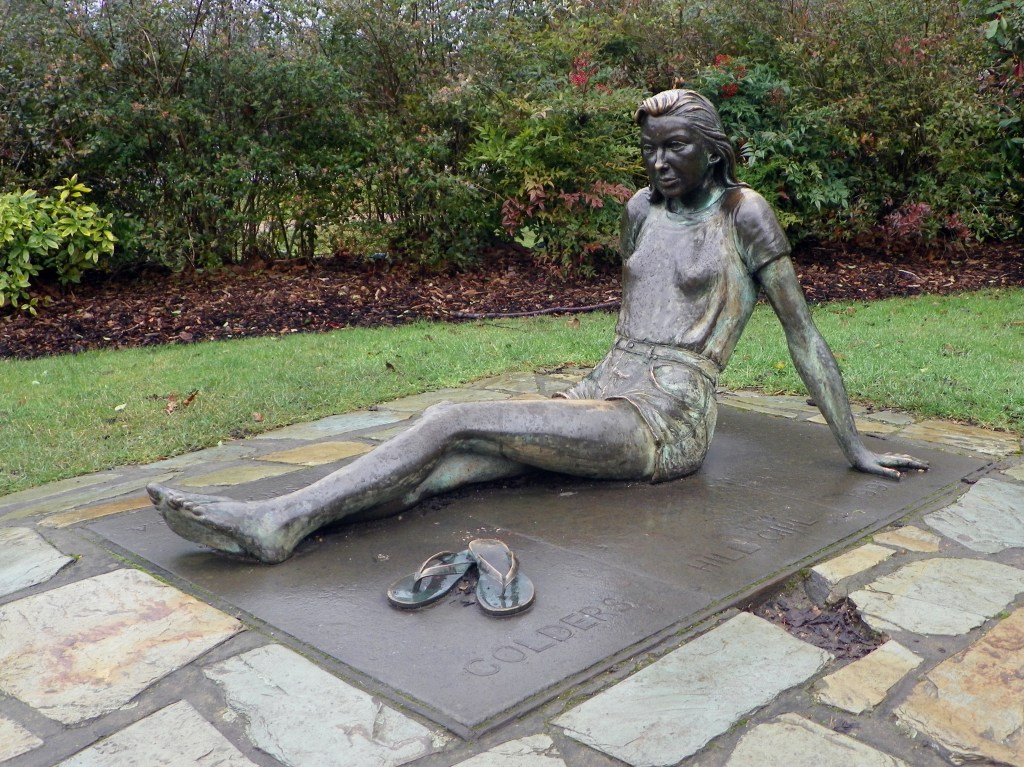
You know me but you don’t know my name. It’s Beth. And I’ve been lounging in the same spot for 35 years now. I had a mummy once, her name was Patricia Finch, so you could say that my name is Beth Finch. Patricia died in 2001 ten years after creating me. I know she loved me because she didn’t want me mouldering in some museum. That’s why she donated me to the park where everyone can admire me. That sounds like I’m a show off, but I’m not really. And you can’t accuse me of posing. I’m just a girl sunbathing, even though all seasons are the same to me. So, if you’re considering wrapping a scarf around my neck and shoulders when it gets chilly, thank you, but it’s not necessary. The gear definitely suits me don’t you think? Wait! You, yes you, gawping at my breasts beneath my t-shirt. Please stop. Patricia never intended me to be a pin-up, just a regular girl with a regular body. All the same, I’m very proud of my legs: strong legs on a strong girl. Don’t worry about me having to support myself with my arms planted either side of my bod: pins and needles are not an issue for statues. And if I’m not exactly smiling, that could be because I do a lot of thinking. Thoughtful of Patricia to provide me with a pair of flip flops, but I’ll never slip them on ‘cos I’m not going anywhere, am I? By the way: the upside of being a statue is that you never age. Children who were first brought to see me when they were babes in arms, are all grown now with sprogs of their own. Come and visit me any time you’re in the area; I might even manage a wink of an eye if no one else is looking. But please, no gawpers.
Reader: I married him
Rainham Federation Cemetery: a bleak windswept stretch of former farmland now home to the remains of thousands of Jews whose bones could do wonders for the fertility of the soil were they not interred in caskets overlaid with slabs of marble.
There, my parents, of blessed memory, are at rest, assured of an annual visit from their only child.
Returning to the bus stop after reciting the regulation mourner’s prayer. I was a little startled when a car drew up and the rear passenger window slid down, and a voice called to me: ‘Do you wanna share a ride to Rainham station?’
I peered in; a snappily-dressed middle-aged man, beckoned: ‘I’m paying for the Uber, if that’s what you’re worried about.’
I vaguely recognized him as the only other visitor I had encountered in the entire cemetery.
I smiled and got in: ‘My parents warned me about accepting lifts from strange men, but I never took any notice.’
He chuckled. I immediately warmed to him. Wavy greying hair, sparkling brown eyes, cleft chin.
‘Maurice Cutter, formerly Schneider,’ he said as he advanced his hand.
‘Max Cohen,’ I replied, grasping his paw in mine.
‘That’s kind of cute,’ he said, ‘we have the same initials.’ Definitely a Yank.
We sat in comfortable silence for the rest of the five-minute trip to Rainham Station, a stop or two before Gravesend.
‘I love your city,’ said Maurice, as we crossed the bridge to the London bound platform, ‘such good transport connections. You don’t drive Max?’
‘I do, but I have a thing about carbon emissions.’
‘Wow, a guy after my own heart.’
That’s when the announcement came through that the next passenger service was delayed due to two goods trains having priority. At Maurice’s suggestion, we recrossed the bridge and got ourselves a coffee on the opposite platform.
‘So, who were you visiting today, Max?
‘Mum and Dad. You?
‘Ex-wife. Didn’t want to be buried on the same continent as me.’
‘You don’t seem such a terrible guy.’
‘Shouldn’t have got married in the first place. By the time we’d had our kids, I realized that I was never going to be happy with a woman, any woman. Excuse me for being frank, Max.’
My heart stood still. My parents grieved when I came out at the age of thirty. They always loved me, but they never got over the disappointment of not having grandchildren.
‘You free for dinner Max?’
‘Only if we go halves.’
‘Like my attorney’s firm doesn’t have an entertainment account.’
Reader: I married him.
 Lawrence Cohen Writing